Tuesday, March 27, 2018

2017 United Herzlia Schools results ..... excellent ... mazel tov!!!!


PRESS RELEASE
HERZLIA MATRIC RESULTS 2017

Herzlia High School:  2017 Matric Results Press release

General Statistics:
  • 93 matric candidates
  • 100% pass rate
  • 86 candidates awarded a Bachelor's pass (University Exemption) - 92.5%
  • 284 individual subject distinctions
  • An average of 3.3 distinctions per candidate
  • 45% of candidates achieved 4 or more distinctions
  • A very impressive 78% overall subject aggregate, an improvement on last year
  • All 15 pupils in the Ed Support programme passed every subject
  • Not one subject failure

Subjects with over 60% of candidates achieving distinctions
Subject
Number of Candidates
Distinctions achieved
Accounting
15
14
Computer Applications Technology
6
5
Design
9
8
Economics
51
38
History
24
17
Music
2
2
Physical Science
27
18
Visual Art
16
11


MARC FALCONER
PRINCIPAL, HERZLIA HIGH SCHOOL
MH Goldschmidt Avenue, Highlands Estate, Cape Town, 8001
PO Box 3508, Cape Town, 8000
Tel: +27 21 464 3300  Fax: +27 21 461 8834 Email: mfalconer@herzlia.com Web: www.herzlia.com

Monday, March 19, 2018

The Water Crisis In Cape Town .... behind the scenes by the Bard of Bat Yam (#BardOfBatYam), Poet Lareate of Zion (#PoetLaureateOfZion) and Stephen Darori


What's Actually Behind Cape Town's Water Crisis

Blame austerity-obsessed technocrats, irresponsible development, and willful ignorance.
A  f
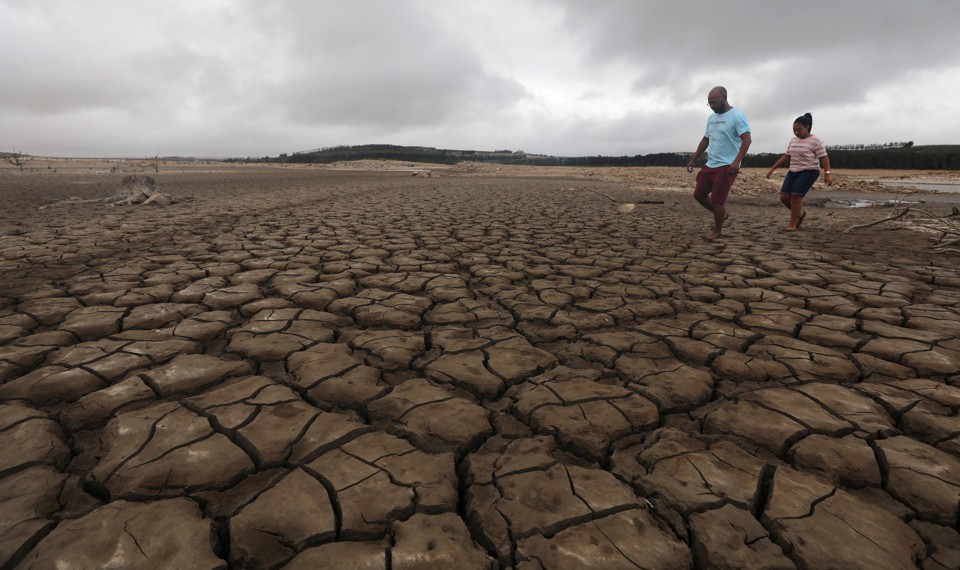
amily negotiates their way through caked mud around a dried up section of the Theewaterskloof dam near Cape Town, South Africa,

The city of Cape Town was plonked by its founders onto a peninsula not far from where the Indian and Atlantic oceans merge, often violently, beneath the imposing banks of Table Mountain. To its north lie the fertile fruit and wine farms that weigh down the city’s restaurant tables with unimaginable bounty. Every day when the clock strikes noon, a cannon blast echoes from Signal Hill, a reminder of the city’s colonial heritage. It was established first as a vegetable garden by the Dutch East India Company in 1652, then repurposed as a stronghold for the British until the formation of the Union of South Africa in 1910; later it served as the apartheid regime’s parliamentary stronghold. In 2014, The New York Timesdeclared it the best place in the world to visit. Britain’s Daily Telegraph concurred.

Today, Cape Town faces two catastrophic, extinction-level botherations. First, the rains that once fell so reliably during the winter months have tailed off. For the past three years, they have barely fallen at all—a phenomenon one meteorologist calls a once-in-628-years weather event. Second, Cape Town is one of the more unequal cities on earth, with the wealthy, mostly white, population living in toney coastal and inland suburbs, and the poor, mostly black, inhabitants shunted onto the flatlands, an hours-long commute from the city’s economic hub.

By current calculations, “Day Zero,” the dystopian term for the date by which the city is expected to run out of water, and when all water will be rerouted to emergency pick up points, is June 4. This will mark the first time that a major modern city has run out of municipal water. In 2008, Barcelona came close. Sao Paulo, the biggest city in the Western Hemisphere, teeters on the brink. The government of Indonesia has given serious consideration to abandoning chunks of Jakarta, which is paradoxically sinking below sea level, drowning in torrential rains, and running out of potable water. What is now certain is that Cape Town will become a test case for what happens when climate change, extreme inequality, and partisan political dysfunction collide.

Perhaps the most confounding thing about Cape Town is its whiplash-inducing contradictions. Its highways, airport, shopping malls, and restaurants, would be the envy of any American municipality. While corruption certainly exists in Cape Town, until the whole place started melting down last year it was the only metro in South Africa to receive clean audits. Yet hundreds of thousands of people live in shacks and informal settlements, with access mostly limited to a shoddy rail system and an expensive private mini-bus taxi network. In this regard, Cape Town is both an African city and a European outpost at the bottom of Africa, at once developing and developed.

So how does an ostensibly well-run city manage to blow the water file so spectacularly? In part, it comes down to the fact that its administration was paralyzed by a sort of bureaucratic magical thinking that combined technocratic hyper-efficiency, an obsession with austerity-driven bean-counting, and an apparent belief that miracles are certain to fall from the sky.

Since 2009, the Western Cape, of which Cape Town is the capital, has been governed by the Democratic Alliance (DA), the official opposition to the African National Congress (ANC). (A DA-led coalition won Cape Town from the ANC in 2006. They now run the city outright.) The DA is a strange beast, a party with a white-dominated federal executive, and, until 2015, a white leader. There’s a longstanding perception that the party serves the white population’s agenda, described by its enemies as maintaining economic apartheid at the expense of black advancement—a notion that Cape Town’s spatial divisions reinforce. (The party’s former leader, Helen Zille, who has also served as Cape Town’s executive mayor, has a habit of posting tweets extolling the benefits of colonialism, which hasn’t helped matters much.) Culturally and politically, the Cape is a world apart from the rest of South Africa.

Accordingly, the DA has long pitched itself to voters as a “clean” version of the horrifically corrupt ANC—it self-identifies as a liberal, social-democratic party in the stodgy German mold. Back when the ANC ran Cape Town, the rains fell mostly on schedule, and planning for the worst took a back seat to systemic corruption. The DA promised that it would do better. Instead, it has been bad, but in its own special ways. Its near-messianic adherence to fiscal rectitude has meant that local bureaucrats have tended to ignore repeated warnings from civil engineers and climate scientists, who insisted that Cape Town’s water infrastructure, which relies exclusively on six dams in parched catchment areas, would not be able to meet demand should rainfall patterns change due to climate change. Theewaterskloof Dam, the biggest and most vital feeder site, is in an area of the Western Cape that has been subject to creeping desertification for at least a decade. It is currently at 11.7 to 12.5 percent of its capacity, and effectively unusable.

The drought is so severe that planning for it would take genuine governmental prescience. But over the years, the Cape Town government has studiously ignored reams of data and studies readily available in the public domain. One of the first warnings that Cape Town would run dry was published in the Cape Timesin 1990. Scientists, meteorologists, engineers and lay-folk have echoed those warnings in the years since. Emergency measures were considered and abandoned, with weather-like caprice: Desalination plants were deemed too expensive and cumbersome for a situation that the city’s bureaucrats believed would resolve itself. A fully completed plant in the nearby Mossel Bay municipality was mothballed in 2011; at slightly less than a dollar a kiloliter, the water it produced was deemed too expensive.

The DA has also encouraged big-money development in the city bowl and in coastal areas, which has massively driven up property prices and made stalwart allies (and donors) of the property developer class. Blue-chip, unsustainable developments populate the rich areas, and critics of the city’s policies insist that they churn through more than their share of water. The irony here is that if the city had been more amenable to mixed-income projects, there’d be far fewer wealthy water consumers along the thirsty coast, and more residents that conserve—largely because they wouldn’t be able to afford to do otherwise.

Of course, you can’t tell this story without mentioning the national government, dominated since the dawn of democracy by the dysfunctional ANC. While South Africa’s constitution placed the municipal water systems under the stewardship of local government, management of the so-called “bulk” national infrastructure—the larger networks that govern water delivery—falls to Department of Water and Sanitation Minister Nomvula Mokonyane. She seems to have no interest in her portfolio. Across the country, because of the usual combination of drought and mismanagement, water shutdowns in smaller communities have become the norm. Mokonyane has blamed the creeping nightmare on over-consumption. Regardless, water for many South Africans is steadily becoming a just another out-of-reach luxury product.

Jacob Zuma, who resigned as South Africa’s presidentand was succeeded by an economy-obsessed, Davos-endorsed technocrat named Cyril Ramaphosa. He is unlikely to be so sanguine regarding Cape Town’s floundering. Compounding all of this is the fact that the Cape Town government was unwilling to admit the scale of the crisis, even to itself, until the middle of last year. In January 2018, the city finally announced that, starting on February 1, households consuming more than 350 liters of water a day would face fines and the installation of a water-management device on their property.

This cued the usual complaints: Why should the wealthy, who pay the most in rates and taxes, effectively subsidize water consumption in poor communities and in the farmlands, while facing a curtailment of the services they effectively underwrite? And why should high-income, tourist-friendly neighborhoods like Mouille Point be forced to host potential desalination plants, noisy eyesores that could just as easily be set up in less “desirable” communities? On the flipside, as a township resident and reporter named Suné Payne put it: “If my household of nine can survive on less than 350 liters of water a day, why can’t others?” In Cape Town, the poor have always faced water restrictions. “There used to be a name for it,” remarked one activist. “Apartheid.”

All of this can be avoided, or at least delayed, if consumption can be choked off at around 450 million liters per day. Farmers have been forced to accept the fact that their crops and vineyards will not receive water that was once shared with the municipality. This means a huge spike in food prices in the coming months. The city has devised what is being called a water pick-up point system, in which approximately 200 sites have been identified from which 25 liters will be distributed to 20,000 eligible residents each a day.

But details on how this scheme will work are sketchy. What contortions must an elderly person or a woman with two children endure in order to schlep all that water? The city also has yet to specify how these points will be policed. According to Richard Bosman, the city’s executive director for safety and security, “The risk grading will be done in accordance with the volume of people expected to pass through each water collection point, as well as the general crime trends in each area. Cape Town does have a number of gang hot spots and so this would be a crucial factor in determining whether a collection point is considered low or high risk.” There has been no elaboration on what this RoboCop-speak means, nor what it would entail. Meanwhile, Patricia De Lille, Cape Town’s executive mayor, has been accused of mismanagement and corruption; she faces a no-confidence vote today.

So what is to be done? In an age in which both the climate and politicians have gone rogue, the only good thing that can come of Cape Town’s crisis is how eloquently its inhabitants come up with new definitions of resilience. What unfolds in the next few months has a massive impact on the lives of all South Africans—cholera won’t stop at the foot of Table Mountain—but it also suggests a way forward for the rest of the world. Drought, or rather climate change, is only part of the reason that Cape Town is dying of thirst. The other failings are more readily addressed, but seem far more intractable.

Saturday, February 24, 2018

1974 in South Africa


The Doll House Drive-in Restaurant, Mouille Point, Cape Town 1974


Incumbents

State President: Jim Fouché.
Prime Minister: John Vorster.
Chief Justice: Newton Ogilvie Thompson then Frans Lourens Herman Rumpff.


John Voster laying a wreah at Yad Vashem (in 1976 at the invitation of Shimon Peres who visited South Africa in the same year)


Events


January
4 – Harry Schwarz and Chief Minister of KwaZulu Gatsha Buthelezi sign the Mahlabatini Declaration of Faith.
11 – David, Elizabeth, Emma, Grant, Jason and Nicolette Rosenkowitz are born in Cape Town, the first sextuplets in the world where all six babies survive.


March
18 – Members of the World Council of Churches's Executive or Central Committee are banned from South Africa.
19 – The Narcotics Bureau of the South African Police is established.
19 – Harry Schwarz and Chief Minister Cedric Phatudi of Lebowa sign the Seshego Declaration.


April
24 – A whites only general election takes place and is won by the National Party.
25 – A coup in Portugal leads to that country's withdrawal from its colonies in Angola and Mozambique.


May
6 May – The British and Irish Lions begin a controversial twenty-two match rugby union tour of South Africa and Rhodesia.
29 – Prime Minister of South Africa John Vorster and Prime Minister of Rhodesia Ian Smith meet and agree to co-operative co-existence with and non-interference in the internal affairs of a black-ruled Mozambique.


John Voster and Ian Smith

June
5 – The Japanese government announces that South Africans will no longer be granted visas to enter Japan.


July
7 – New Zealand imposes a blanket ban on sports teams from South Africa.


September
22–23 – Prime Minister of South Africa John Vorster and President of Côte d'Ivoire Félix Houphouët-Boignyhold talks.


October
25 – Pik Botha declares at the United Nations that South Africa is beginning to make far-reaching reforms.


November
26 – Anneline Kriel is crowned as Miss World 1974, the second South African to hold the title after Penny Coelen in 1958, when Helen Morgan resigns four days after winning the 24th Miss World pageant.
Image result for Anneline Kriel
Then aged 19 and now aged 63

Thursday, April 27, 2017

South Africa celebrates 23 years of Freedom today! Zapiro's archival Mandela Sunrise cartoon 27 April 1994 published then in Weekly Mail.


No  No No.....Nelson Mandela , the happy pill of South Africa simply kept the lid on ANC corruption and mismanagement ..... when he went Jacob Zuma and his ANC honchos were all ready in full swing mismanaging the country. Time for Change!! DA instead of ANC!
Celebrate!!!! There is nothing to celebrate. Nearly everything is destroyed. That was drawn in 1994 What he draws now is quite different. SA is destroyed finished and klaar. The latest destruction :- Coligny. Property stolen and destroyed from people who had nothing to do with the drama of a child allegedly killed outside of town. I hope everyone affected will close down and move away.

This is where the current problems started. This cartoon illustrates how South Africans thought that Nelson Mandela's existence would save us all and make life perfect. It took him, and thousands of others, 50 years of extreme hardship, suffering and sacrifice to bring about the end of Apartheid. In 1994 his work was over. It was, and is, up to the rest of us to create a free, decent, just society in which everyone 's basic needs are met. After 342 years of discrimination and oppression of one group by another the right to vote was just one tiny step in what should have been a massive, concerted, well-planned, focused and ongoing effort on the part of every citizen. 23 years later we still haven't learned this lesson. Hence the massive poverty, unemployment and crime.


Saturday, April 8, 2017

Cameos From Zion: Merrry de La Grey by the Bard of Bat Yam, Poet Lau...

Cameos From Zion: Merrry de La Grey by the Bard of Bat Yam, Poet Lau...: Cats are among life's precious jewels and kinship They are sweet, funny cute, genuine and rare, They are what we call loyalty and fri...

We The Whites Of South Africa Manifesto Hey Ho We Better Keep calm … and shut up!


We the South African voters have spoken in the local government election, and we said many different things. Let’s give votes and cities (in part or whole) to the main opposition party, the Democratic Alliance (DA). Let’s give some votes and the municipality where President Jacob Zuma’s homestead of Nkandla is situated to the Inkatha Freedom Party (IFP).

Also, let’s give some votes but no cities to the militant Economic Freedom Fighters (EFF), and small parcels of votes to many, many others.

We as voters have embraced pluralism and competition. It seems to have come as something of a shock to the leaders of the African National Congress (ANC), for some reason. Perhaps the hefty R1 billion the ANC used for campaigning would be better spent on some decent polling.

We also said, as an electorate, let’s take votes – and cities – away from the ANC. Whether the various parties of the opposition attracted our votes, or the ANC leadership repelled us and our votes through their arrogance and brazen corruption, remains a key research question facing academics and politicians.

For local governments in the country’s wealthiest province of Gauteng, in particular, where delivery has been way above the national average, this is a gloomy question. Where did all that hard work go? Was it simply insufficient for a 21st-century “world-class” set of cities?

Why did national credit downgrading matter so much to everyone, but city upgrading by the same agencies of Johannesburg to AA1 status mattered not a jot?

Bluntly, did the rot from the centre suppurate through to voters who may otherwise have rated the metropole of Johannesburg, its mayor Parks Tau and members of the mayoral committee (MMCs) as working well for us? Did we throw out the Tau with the bathwater, in anger and frustration at his ANC overlords?

This question – of blame, simply put – is likely to be at the heart of post-election ANC manoeuvring. Whether the interests of voters will be taken into account is an open question.
Free and fair and (too) fast

To add hubris to the mess, the Independent Electoral Commission (IEC) was brazen enough to host an end-of-election event, declaring the entire endeavour free and fair. This, even while the vote for the economic and provincial capital, Johannesburg, remained incomplete and subject to dispute in multiple wards. Really?

The audacity of the IEC was breathtaking. It would be rather like the Brexit vote being declared while still counting the London votes.

Twitterati breathlessly told us that the IEC emerged from the election well, with its reputation regained after its own tango with corruption and maladministration. Apparently our appetite for a clean institution is so large and urgent that we are willing to allow such incidents to occur, relieved that at least most of the vote had been free and fair, and the IEC seemed to smell of roses.

Then the young women of the EFF stood in mute protest as Zuma spoke at the IEC election centre after the polls in Pretoria. They reminded us of the rape charge and trial of the president a decade ago (he was acquitted), asking profound questions about the moral basis of leadership – and did so just metres away from Zuma, while he bumbled through the usual pleasantries of a captain watching his ship sinking while trying to keep the passengers calm.

Zuma’s security detail – presumably gobsmacked that these young women completely outmanoeuvred their assumed tactical astuteness and training and little plastic ear wires and big guns – were rather less presidential in their handling of the young women.

Strong men shoving around young women – the tableaux acted out exactly what the women were protesting. The women are university students, doing what students do best – cocking a snoop at authority in pursuit of their beliefs. Setting a rather presidential example, it may be noted.
Anti-rape protesters being removed as Jacob Zuma spoke in Pretoria.

Since then, the social media landscape has been alight with awkward camera angles, muffled sound and snippets of gossip – did female ANC cabinet ministers really round on one of their own for the lapse in security? Was Zuma heard shouting his anger? Who were the women? Why were they screaming when led away? Did the rest of the EFF contingent know of the protest, as they hastily made for the door, apparently refusing to listen to Zuma?
Snide, rude and arrogant

But perhaps the worst thing to happen is that someone told DA former party leader and Western Cape Premier Helen Zille she could stop hiding and start tweeting again. Life is tough enough for whiteys without her assuming to insert snide, often rude and arrogant tweets into whatever debate she feels needs her special attention.

Universities have been literally aflame for almost a year, but this did not stop Zille from tweeting to a #feesmustfall group that:


If this woke bunch hate being UCT students so much, pls help them out of their misery and withdraw their funding.

Political writer Richard Poplak has already eviscerated the tweet and the twit who wrote it. Just what we need – stupid, snide, entirely lacking in compassion, suggesting a flatlined learning curve. And unassailably white on the scale of snottiness and lack of empathy.

Not that anyone asked, but if they did I’d say to fellow white voters, “Stay Calm – but (not just you Helen Zille) please shut up!” The massive change we have witnessed; the “new narrative” that has welcomed pluralism and jettisoned the much-peddled factoid of 2014’s national election, that we were all heading to doom, death and decay – or, worse, Zimbabwean basket-case status; these things have not been done by white people, though we may have been part of the change.
Elections are not a racial census

We do not bear “the white man’s [sic] burden” of being the gatekeeper of liberal democracy, even though various commentators over the last 22 years have told us that black people vote blindly for ANC governments – that elections are a racial census.

These supposed political scientists argued for years that the black vote – that key item lying at the heart of the struggle for democracy – was actually the biggest threat to democracy, because the “natives” kept electing ANC governments. If anyone wanted a better example of why the academy needs a dramatic post-colonial overhaul, read 22 years of election analysis, and weep quietly.

But now these have been debunked by us voters. The academics trotting out these tropes have been shown to write utter tosh; and one can only hope that we all accept – and all will accept us – as part of a massive social revolution that began in 1990 and is still taking shape, unravelling from the violence and racism and psychological scarring of the past and moving restlessly into an unknown future.

It cannot do so where whites or blacks silence one another – but it also cannot thrive where black or white claim credit for the victories of democracy.

We – all of us, in our resplendent variety as voters – we did this. Whites did it. Blacks did it. Coloureds did it. Indians did it. Gay and straight, LGBTIAQ+ and staunchly religious conservatives and atheists, surfers and tiddly-winks players, we all did it.

So let’s own it as a collective victory against those who sit in power and disregard us as voting fodder. The only winner in the local elections of 2016 is the only winner that matters – you and I, the South African voter.