Showing posts with label #CameosfromCapeTown. Show all posts

Monday, March 19, 2018

The Water Crisis In Cape Town .... behind the scenes by the Bard of Bat Yam (#BardOfBatYam), Poet Lareate of Zion (#PoetLaureateOfZion) and Stephen Darori


What's Actually Behind Cape Town's Water Crisis

Blame austerity-obsessed technocrats, irresponsible development, and willful ignorance.
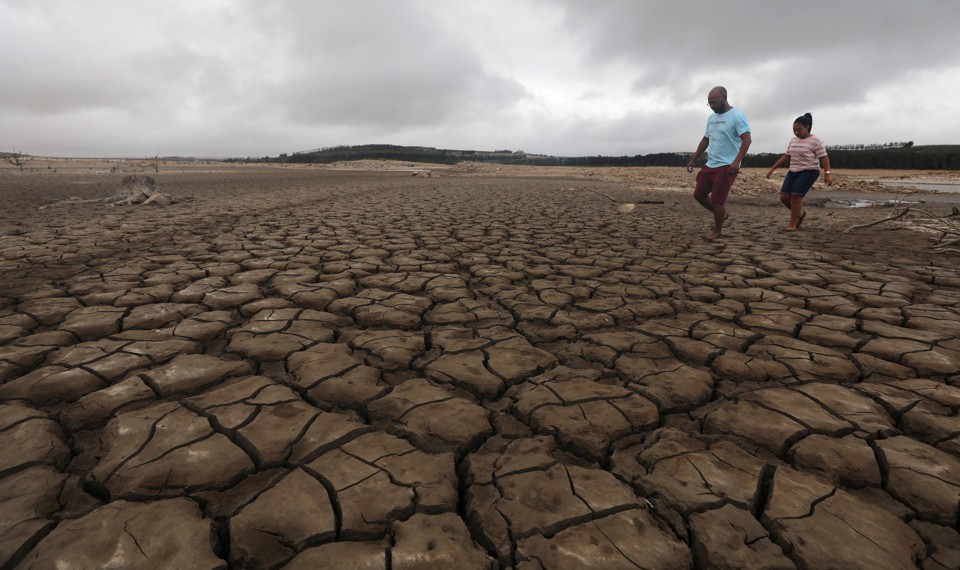
A  f
amily negotiates their way through caked mud around a dried up section of the Theewaterskloof dam near Cape Town, South Africa,

The city of Cape Town was plonked by its founders onto a peninsula not far from where the Indian and Atlantic oceans merge, often violently, beneath the imposing banks of Table Mountain. To its north lie the fertile fruit and wine farms that weigh down the city’s restaurant tables with unimaginable bounty. Every day when the clock strikes noon, a cannon blast echoes from Signal Hill, a reminder of the city’s colonial heritage. It was established first as a vegetable garden by the Dutch East India Company in 1652, then repurposed as a stronghold for the British until the formation of the Union of South Africa in 1910; later it served as the apartheid regime’s parliamentary stronghold. In 2014, The New York Timesdeclared it the best place in the world to visit. Britain’s Daily Telegraph concurred.

Today, Cape Town faces two catastrophic, extinction-level botherations. First, the rains that once fell so reliably during the winter months have tailed off. For the past three years, they have barely fallen at all—a phenomenon one meteorologist calls a once-in-628-years weather event. Second, Cape Town is one of the more unequal cities on earth, with the wealthy, mostly white, population living in toney coastal and inland suburbs, and the poor, mostly black, inhabitants shunted onto the flatlands, an hours-long commute from the city’s economic hub.

By current calculations, “Day Zero,” the dystopian term for the date by which the city is expected to run out of water, and when all water will be rerouted to emergency pick up points, is June 4. This will mark the first time that a major modern city has run out of municipal water. In 2008, Barcelona came close. Sao Paulo, the biggest city in the Western Hemisphere, teeters on the brink. The government of Indonesia has given serious consideration to abandoning chunks of Jakarta, which is paradoxically sinking below sea level, drowning in torrential rains, and running out of potable water. What is now certain is that Cape Town will become a test case for what happens when climate change, extreme inequality, and partisan political dysfunction collide.

Perhaps the most confounding thing about Cape Town is its whiplash-inducing contradictions. Its highways, airport, shopping malls, and restaurants, would be the envy of any American municipality. While corruption certainly exists in Cape Town, until the whole place started melting down last year it was the only metro in South Africa to receive clean audits. Yet hundreds of thousands of people live in shacks and informal settlements, with access mostly limited to a shoddy rail system and an expensive private mini-bus taxi network. In this regard, Cape Town is both an African city and a European outpost at the bottom of Africa, at once developing and developed.

So how does an ostensibly well-run city manage to blow the water file so spectacularly? In part, it comes down to the fact that its administration was paralyzed by a sort of bureaucratic magical thinking that combined technocratic hyper-efficiency, an obsession with austerity-driven bean-counting, and an apparent belief that miracles are certain to fall from the sky.

Since 2009, the Western Cape, of which Cape Town is the capital, has been governed by the Democratic Alliance (DA), the official opposition to the African National Congress (ANC). (A DA-led coalition won Cape Town from the ANC in 2006. They now run the city outright.) The DA is a strange beast, a party with a white-dominated federal executive, and, until 2015, a white leader. There’s a longstanding perception that the party serves the white population’s agenda, described by its enemies as maintaining economic apartheid at the expense of black advancement—a notion that Cape Town’s spatial divisions reinforce. (The party’s former leader, Helen Zille, who has also served as Cape Town’s executive mayor, has a habit of posting tweets extolling the benefits of colonialism, which hasn’t helped matters much.) Culturally and politically, the Cape is a world apart from the rest of South Africa.

Accordingly, the DA has long pitched itself to voters as a “clean” version of the horrifically corrupt ANC—it self-identifies as a liberal, social-democratic party in the stodgy German mold. Back when the ANC ran Cape Town, the rains fell mostly on schedule, and planning for the worst took a back seat to systemic corruption. The DA promised that it would do better. Instead, it has been bad, but in its own special ways. Its near-messianic adherence to fiscal rectitude has meant that local bureaucrats have tended to ignore repeated warnings from civil engineers and climate scientists, who insisted that Cape Town’s water infrastructure, which relies exclusively on six dams in parched catchment areas, would not be able to meet demand should rainfall patterns change due to climate change. Theewaterskloof Dam, the biggest and most vital feeder site, is in an area of the Western Cape that has been subject to creeping desertification for at least a decade. It is currently at 11.7 to 12.5 percent of its capacity, and effectively unusable.

The drought is so severe that planning for it would take genuine governmental prescience. But over the years, the Cape Town government has studiously ignored reams of data and studies readily available in the public domain. One of the first warnings that Cape Town would run dry was published in the Cape Timesin 1990. Scientists, meteorologists, engineers and lay-folk have echoed those warnings in the years since. Emergency measures were considered and abandoned, with weather-like caprice: Desalination plants were deemed too expensive and cumbersome for a situation that the city’s bureaucrats believed would resolve itself. A fully completed plant in the nearby Mossel Bay municipality was mothballed in 2011; at slightly less than a dollar a kiloliter, the water it produced was deemed too expensive.

The DA has also encouraged big-money development in the city bowl and in coastal areas, which has massively driven up property prices and made stalwart allies (and donors) of the property developer class. Blue-chip, unsustainable developments populate the rich areas, and critics of the city’s policies insist that they churn through more than their share of water. The irony here is that if the city had been more amenable to mixed-income projects, there’d be far fewer wealthy water consumers along the thirsty coast, and more residents that conserve—largely because they wouldn’t be able to afford to do otherwise.

Of course, you can’t tell this story without mentioning the national government, dominated since the dawn of democracy by the dysfunctional ANC. While South Africa’s constitution placed the municipal water systems under the stewardship of local government, management of the so-called “bulk” national infrastructure—the larger networks that govern water delivery—falls to Department of Water and Sanitation Minister Nomvula Mokonyane. She seems to have no interest in her portfolio. Across the country, because of the usual combination of drought and mismanagement, water shutdowns in smaller communities have become the norm. Mokonyane has blamed the creeping nightmare on over-consumption. Regardless, water for many South Africans is steadily becoming a just another out-of-reach luxury product.

Jacob Zuma, who resigned as South Africa’s presidentand was succeeded by an economy-obsessed, Davos-endorsed technocrat named Cyril Ramaphosa. He is unlikely to be so sanguine regarding Cape Town’s floundering. Compounding all of this is the fact that the Cape Town government was unwilling to admit the scale of the crisis, even to itself, until the middle of last year. In January 2018, the city finally announced that, starting on February 1, households consuming more than 350 liters of water a day would face fines and the installation of a water-management device on their property.

This cued the usual complaints: Why should the wealthy, who pay the most in rates and taxes, effectively subsidize water consumption in poor communities and in the farmlands, while facing a curtailment of the services they effectively underwrite? And why should high-income, tourist-friendly neighborhoods like Mouille Point be forced to host potential desalination plants, noisy eyesores that could just as easily be set up in less “desirable” communities? On the flipside, as a township resident and reporter named SunĂ© Payne put it: “If my household of nine can survive on less than 350 liters of water a day, why can’t others?” In Cape Town, the poor have always faced water restrictions. “There used to be a name for it,” remarked one activist. “Apartheid.”

All of this can be avoided, or at least delayed, if consumption can be choked off at around 450 million liters per day. Farmers have been forced to accept the fact that their crops and vineyards will not receive water that was once shared with the municipality. This means a huge spike in food prices in the coming months. The city has devised what is being called a water pick-up point system, in which approximately 200 sites have been identified from which 25 liters will be distributed to 20,000 eligible residents each a day.

But details on how this scheme will work are sketchy. What contortions must an elderly person or a woman with two children endure in order to schlep all that water? The city also has yet to specify how these points will be policed. According to Richard Bosman, the city’s executive director for safety and security, “The risk grading will be done in accordance with the volume of people expected to pass through each water collection point, as well as the general crime trends in each area. Cape Town does have a number of gang hot spots and so this would be a crucial factor in determining whether a collection point is considered low or high risk.” There has been no elaboration on what this RoboCop-speak means, nor what it would entail. Meanwhile, Patricia De Lille, Cape Town’s executive mayor, has been accused of mismanagement and corruption; she faces a no-confidence vote today.

So what is to be done? In an age in which both the climate and politicians have gone rogue, the only good thing that can come of Cape Town’s crisis is how eloquently its inhabitants come up with new definitions of resilience. What unfolds in the next few months has a massive impact on the lives of all South Africans—cholera won’t stop at the foot of Table Mountain—but it also suggests a way forward for the rest of the world. Drought, or rather climate change, is only part of the reason that Cape Town is dying of thirst. The other failings are more readily addressed, but seem far more intractable.

Thursday, April 27, 2017

South Africa celebrates 23 years of Freedom today! Zapiro's archival Mandela Sunrise cartoon 27 April 1994 published then in Weekly Mail.


No  No No.....Nelson Mandela , the happy pill of South Africa simply kept the lid on ANC corruption and mismanagement ..... when he went Jacob Zuma and his ANC honchos were all ready in full swing mismanaging the country. Time for Change!! DA instead of ANC!
Celebrate!!!! There is nothing to celebrate. Nearly everything is destroyed. That was drawn in 1994 What he draws now is quite different. SA is destroyed finished and klaar. The latest destruction :- Coligny. Property stolen and destroyed from people who had nothing to do with the drama of a child allegedly killed outside of town. I hope everyone affected will close down and move away.

This is where the current problems started. This cartoon illustrates how South Africans thought that Nelson Mandela's existence would save us all and make life perfect. It took him, and thousands of others, 50 years of extreme hardship, suffering and sacrifice to bring about the end of Apartheid. In 1994 his work was over. It was, and is, up to the rest of us to create a free, decent, just society in which everyone 's basic needs are met. After 342 years of discrimination and oppression of one group by another the right to vote was just one tiny step in what should have been a massive, concerted, well-planned, focused and ongoing effort on the part of every citizen. 23 years later we still haven't learned this lesson. Hence the massive poverty, unemployment and crime.


Saturday, April 8, 2017

We The Whites Of South Africa Manifesto Hey Ho We Better Keep calm … and shut up!


We the South African voters have spoken in the local government election, and we said many different things. Let’s give votes and cities (in part or whole) to the main opposition party, the Democratic Alliance (DA). Let’s give some votes and the municipality where President Jacob Zuma’s homestead of Nkandla is situated to the Inkatha Freedom Party (IFP).

Also, let’s give some votes but no cities to the militant Economic Freedom Fighters (EFF), and small parcels of votes to many, many others.

We as voters have embraced pluralism and competition. It seems to have come as something of a shock to the leaders of the African National Congress (ANC), for some reason. Perhaps the hefty R1 billion the ANC used for campaigning would be better spent on some decent polling.

We also said, as an electorate, let’s take votes – and cities – away from the ANC. Whether the various parties of the opposition attracted our votes, or the ANC leadership repelled us and our votes through their arrogance and brazen corruption, remains a key research question facing academics and politicians.

For local governments in the country’s wealthiest province of Gauteng, in particular, where delivery has been way above the national average, this is a gloomy question. Where did all that hard work go? Was it simply insufficient for a 21st-century “world-class” set of cities?

Why did national credit downgrading matter so much to everyone, but city upgrading by the same agencies of Johannesburg to AA1 status mattered not a jot?

Bluntly, did the rot from the centre suppurate through to voters who may otherwise have rated the metropole of Johannesburg, its mayor Parks Tau and members of the mayoral committee (MMCs) as working well for us? Did we throw out the Tau with the bathwater, in anger and frustration at his ANC overlords?

This question – of blame, simply put – is likely to be at the heart of post-election ANC manoeuvring. Whether the interests of voters will be taken into account is an open question.
Free and fair and (too) fast

To add hubris to the mess, the Independent Electoral Commission (IEC) was brazen enough to host an end-of-election event, declaring the entire endeavour free and fair. This, even while the vote for the economic and provincial capital, Johannesburg, remained incomplete and subject to dispute in multiple wards. Really?

The audacity of the IEC was breathtaking. It would be rather like the Brexit vote being declared while still counting the London votes.

Twitterati breathlessly told us that the IEC emerged from the election well, with its reputation regained after its own tango with corruption and maladministration. Apparently our appetite for a clean institution is so large and urgent that we are willing to allow such incidents to occur, relieved that at least most of the vote had been free and fair, and the IEC seemed to smell of roses.

Then the young women of the EFF stood in mute protest as Zuma spoke at the IEC election centre after the polls in Pretoria. They reminded us of the rape charge and trial of the president a decade ago (he was acquitted), asking profound questions about the moral basis of leadership – and did so just metres away from Zuma, while he bumbled through the usual pleasantries of a captain watching his ship sinking while trying to keep the passengers calm.

Zuma’s security detail – presumably gobsmacked that these young women completely outmanoeuvred their assumed tactical astuteness and training and little plastic ear wires and big guns – were rather less presidential in their handling of the young women.

Strong men shoving around young women – the tableaux acted out exactly what the women were protesting. The women are university students, doing what students do best – cocking a snoop at authority in pursuit of their beliefs. Setting a rather presidential example, it may be noted.
Anti-rape protesters being removed as Jacob Zuma spoke in Pretoria.

Since then, the social media landscape has been alight with awkward camera angles, muffled sound and snippets of gossip – did female ANC cabinet ministers really round on one of their own for the lapse in security? Was Zuma heard shouting his anger? Who were the women? Why were they screaming when led away? Did the rest of the EFF contingent know of the protest, as they hastily made for the door, apparently refusing to listen to Zuma?
Snide, rude and arrogant

But perhaps the worst thing to happen is that someone told DA former party leader and Western Cape Premier Helen Zille she could stop hiding and start tweeting again. Life is tough enough for whiteys without her assuming to insert snide, often rude and arrogant tweets into whatever debate she feels needs her special attention.

Universities have been literally aflame for almost a year, but this did not stop Zille from tweeting to a #feesmustfall group that:


If this woke bunch hate being UCT students so much, pls help them out of their misery and withdraw their funding.

Political writer Richard Poplak has already eviscerated the tweet and the twit who wrote it. Just what we need – stupid, snide, entirely lacking in compassion, suggesting a flatlined learning curve. And unassailably white on the scale of snottiness and lack of empathy.

Not that anyone asked, but if they did I’d say to fellow white voters, “Stay Calm – but (not just you Helen Zille) please shut up!” The massive change we have witnessed; the “new narrative” that has welcomed pluralism and jettisoned the much-peddled factoid of 2014’s national election, that we were all heading to doom, death and decay – or, worse, Zimbabwean basket-case status; these things have not been done by white people, though we may have been part of the change.
Elections are not a racial census

We do not bear “the white man’s [sic] burden” of being the gatekeeper of liberal democracy, even though various commentators over the last 22 years have told us that black people vote blindly for ANC governments – that elections are a racial census.

These supposed political scientists argued for years that the black vote – that key item lying at the heart of the struggle for democracy – was actually the biggest threat to democracy, because the “natives” kept electing ANC governments. If anyone wanted a better example of why the academy needs a dramatic post-colonial overhaul, read 22 years of election analysis, and weep quietly.

But now these have been debunked by us voters. The academics trotting out these tropes have been shown to write utter tosh; and one can only hope that we all accept – and all will accept us – as part of a massive social revolution that began in 1990 and is still taking shape, unravelling from the violence and racism and psychological scarring of the past and moving restlessly into an unknown future.

It cannot do so where whites or blacks silence one another – but it also cannot thrive where black or white claim credit for the victories of democracy.

We – all of us, in our resplendent variety as voters – we did this. Whites did it. Blacks did it. Coloureds did it. Indians did it. Gay and straight, LGBTIAQ+ and staunchly religious conservatives and atheists, surfers and tiddly-winks players, we all did it.

So let’s own it as a collective victory against those who sit in power and disregard us as voting fodder. The only winner in the local elections of 2016 is the only winner that matters – you and I, the South African voter.

Wednesday, March 29, 2017

Former judge takes on Helen Zille's “colonialism” Twitter political correctness head-on

Former judge takes on “colonialism” political correctness head-on

Former Supreme Court Judge Rex van Schalkwyk tackles South Africa’s insidious and debilitating political correctness around colonialism head on, taking us on a global history tour that exposes the shallow current dominant discourse for what it is – errant nonsense. The more frightening prospect is that, in the midst of the official opposition’s turmoil over Western Cape Premier Helen Zille’s tweet about colonialism having conferred benefits on this country, we are establishing a new (and twisted), norm for acceptable free speech. That van Schalkwyk’s voice is almost drowned out in the current media discourse shows just how far we’ve drifted into what is now almost mainstream thinking about what is acceptable and what is not when it comes to expressing your opinion publicly. Adapting to a new Constitutionally-protected and legislatively-equal society is both appropriate and pragmatic. However, what is now evolving is akin to the headmaster, teachers, prefects and classroom bullies colluding to brutally and mercilessly shame and/or silence anyone who differs from them, creating a dysfunctional and fearful behavioural ethic. Some commentators are even claiming (contrary to all of history) that if colonisation, or something similar, had not occurred, the indigenous peoples would have made all the scientific, engineering, medical and other discoveries without outside influence. Pure fantasy, says Van Schalkwyk, who then goes on to show us exactly why. – Chris Bateman


There is something seriously wrong with a society in which it becomes impossible to express an honest opinion. Helen ZIlle’s tweet (never a good idea) contained, essentially, the truth but in the collective hullabaloo that followed, that fact has almost entirely been lost.Former Supreme Court Judge Rex van Schalkwyk

Whatever her critics may say, she never “defended” or “praised” colonialism in any of the opinions that she expressed; she was careful only to have said that colonialism was not all bad. Any disagreement upon this issue (apart from the political inappropriateness of the comment) means, by necessary implication, that colonialism was all bad. Factually, that is demonstrably false.

Apart from the oft-repeated examples of mechanised transport, roads, electricity, water-borne sewerage and the rest, the one colonial manifestation that cannot be escaped is the written, English language. Even an avowed anti-colonialist and sometime hater of all things English (excepting perhaps the game of cricket) like Robert Mugabe, speaks the language with the accent of an Eton graduate.

It is said by some of the Zille critics that all the apparent benefits of the colonial system were initiated for the benefit of the colonisers. Well, of course, that is true; people do things for their own benefit. It is the impulse that has driven creativity throughout the ages. The contention that there was no residual benefit for the victims of colonialism would seek to disprove the most significant force of development and change throughout history. Colonialism or, more accurately, invasions, constitute much of the history of the world, and it all started millennia before the Dutch settlers “colonised” the Cape of Good Hope.

Civilization may have started with the ancient culture of the Babylonians, located in the fertile valley of the Tigris and Euphrates; they were the first to have devolved a written language. This occurred even before the Aryans invaded Europe from the north and spread their influence as far south as North Africa and east into India. Fortunately for the Aryans, their adventures put their illiterate hordes into contact with the people of Babylon from whence came their literacy.Helen Zille’s Twitter storm. More magic available at www.zapiro.com

The ancient written word of Sanskrit, said by some etymologists to have been the first writing, was imported, according to some historians, from the expansionist impulses of the (by now) literate Aryans. The historical accounts vary but need not detain us. The point is simply that migrations, invasions and what has come latterly to be described as colonialism and/or imperialism has occurred throughout history and has invariably imparted, at least, some benefit.

The famed Library at Alexandria, about which many Africans express a glowing pride, was established in the wake of the invasion of North Africa, by Alexander the Great, a Macedonian. The eponymous name of that great institution was derived from the title of the invader.

The Romans introduced the territories that they invaded to a formidable array of skills including engineering, architecture, water reticulation, art and culture and even personal hygiene.

Much the same can be said in the case of South Africa, but if all else is ignored then the English language has conferred great benefits in communication, literacy, literature, culture, science and commerce.


Read also: Stop playing the ANC’s game; get off Zille and do your job – Wilf Nussey

It is true, of course, that if the Dutch colonisers had not arrived, and the English thereafter, as some anti-colonists would wish, that these and perhaps greater benefits may have been derived from some other source. It is uncertain however that any alternative would necessarily have been more benign. The Belgians would almost surely have been worse, if the invasion had occurred during the time of King Leopold.

If the Chinese naval marvel built by the redoubtable Admiral Zheng He in the 15th century AD had not been destroyed upon the command of the isolationist Emperor Hongxi, the peoples of Southern Africa might today be speaking Cantonese.

Some forms of colonialism were undoubtedly far worse than others. If the Dutch settlement at the Cape can be called a colonisation, it was certainly of the more benign kind. The Cape sea route was seen as nothing more than a half-way stop on the long voyage to India, where the real riches were to be found. By comparison the whole of unexplored Southern Africa was seen as no more than a backward and impoverished region with few attractions apart from the strategic one.
The real colonisation occurred when the British might took on the two Boer Republics in an imperial war of aggression. Even that tragic event produced a significant dividend in terms of commercial, banking and other related expertise that had previously been absent.

If an example is sought of pernicious exploitation it is found in the brutal abuse of the people of Vietnam, whose land was occupied, first by the Chinese, for 1000 years, then by the Mongols, then by the French and finally, by the Japanese. But that was not all. The Americans chose that beleaguered land to fight their war of containment against Communist expansion, with a brutality unrivalled in warfare until that time.

Some of the bedraggled survivors chose a refuge by way of a seaborne migration in what has come to be known as the phenomenon of the “boat people”. Those who survived the treacherous voyage, as well as the hostile immigration officials of California, set up their survivalist enterprises in what was sometimes an antagonistic environment. The offspring of these indomitable people are today out-performing their privileged American counterparts at the Ivy League Universities of their adoptive land. And Vietnam is now approaching a First World status similar to that of many of its Asian counterparts.

Collectively, their success lies in the fact that they have left the past behind.

The anti-colonist obsession that has overtaken our dialogue will do nothing to advance the cause of progress. Judging by the reaction of the anti Zille shills it will, however, have the effect of stilling the voice of dissention. What is then to become of the sacred right of the freedom of expression, if even thought processes are now to be controlled?

We have already reached the stage where the accusation of racialism is cast about so indiscriminately that it has become meaningless to any thoughtful observer. However it has had the effect that individuals have become so apprehensive of the prospect of this unjustified slur that they have begun to censor, not only their speech, but even their own thoughts. Indeed I had wondered about the wisdom of putting these ideas in writing.

In a collective quest to be politically correct, is South Africa in danger of becoming a nation of dissemblers? Is this perchance because the thought police have taken control?
Rex van Schalkwyk is a former judge of the Supreme Court of South Africa and is the Chairman of the Free Market Foundation’s Rule of Law Board of Advisers.

Tuesday, March 28, 2017

Catch a Fire is a 2006 biographical thriller film about activists against apartheid in South Africa. The film was directed by Phillip Noyce, from a screenplay written by Shawn Slovo. Slovo's father, Joe Slovo, and mother Ruth First, leaders of the South African Communist Party and activists in the Anti-Apartheid Movement,


Catch A Fire
Catch a fire poster.jpg
US theatrical release poster
Directed byPhillip Noyce
Produced byTim Bevan
Eric Fellner
Anthony Minghella
Robyn Slovo
Written byShawn Slovo
StarringDerek Luke
Tim Robbins
Bonnie Henna
Music byPhilip Miller
CinematographyRon Fortunato
Garry Phillips
Edited byJill Bilcock
Production
companies
Distributed byFocus Features (US)
Universal Pictures International (UK)
Release date
  • 27 October 2006 (US)
  • 23 March 2007 (UK)
Running time
101 min[1]
CountryUnited Kingdom
United States
France
South Africa
LanguageEnglish
Budget$14 million
Box office$5,724,236

Catch a Fire is a 2006 biographical thriller film about activists against apartheid in South Africa. The film was directed by Phillip Noyce, from a screenplay written by Shawn Slovo. Slovo's father, Joe Slovo, and mother Ruth First, leaders of the South African Communist Party and activists in the Anti-Apartheid Movement, appear as characters in the film, while her sister, Robyn Slovo, is one of the film's producers and also plays their mother Ruth First. Catch a Fire was shot on location in South Africa, Swaziland and Mozambique.

Plot
The film begins in "Northern Coalfields, South Africa, 1980". It revolves around Patrick Chamusso, a young, apolitical man (played by Derek Luke) who is accused of carrying out an attack against the government, and an Afrikaner police officer, Nic Vos, played by Tim Robbins. Vos is in charge of locating the perpetrators of a recent bomb attack against the Secunda CTL synthetic fuel refinery, which is the largest coal liquefaction plant in the world.

Patrick is unwillingly swept into Vos's investigation due to his inability to provide a satisfactory explanation for his whereabouts at the time of the bombing (he was actually having an affair with a woman not his wife). Eventually Patrick, his wife, Precious, (played by Bonnie Henna), and his family are tortured and savagely abused by Vos and Vos's subordinates. Desperate, Patrick says that he is willing to confess to a crime he did not commit to protect his family from torture. At last, Vos finally concludes that Patrick is innocent, and orders his release.

Fuelled by the anger at the injustices he and his family suffered, Patrick joins Umkhonto we Sizwe, the guerrilla military wing of the African National Congress and becomes exactly what Vos had initially accused him of being. This decision was an act of revenge against the government for killing his friend and tormenting not only himself but his wife as well. He attempts to execute a plan to attack Secunda, the oil refinery he used to work for, by first bombing its adjacent water supply facilities, and 15 minutes later triggering the main explosion within the refinery itself. This would allow the refinery's workforce to flee between the two explosions, and not be harmed. Also, the damage of the first bomb would reduce the possibility of successfully extinguishing the fire caused by the second, main explosion. Patrick succeeds in the first part, but the second bomb is discovered by Vos and deactivated.

Patrick is arrested and sentenced to 24 years in prison, after his wife goes to Vos and tells him where Patrick is, because she fell for a simple trick in which Vos left photographs of Patrick talking to a female member of the ANC. Through her unjust jealousy she sells him out. He is released early due to the abolition of apartheid.

Precious, who has remarried, is waiting for him and apologizes, and Patrick forgives her and he says he is sorry as well. Some time later, he has been trying to adjust to normal life but the pain he felt wouldn't leave him. One day, he sees Vos sitting out near a small body of water opposite to the side he and friends are on. He creeps over and through some brush sees that it is indeed Vos, and though a part of him wants to break Vos' neck, he decides that it is not worth it, and the real Patrick Chamusso is shown explaining that he told himself then and there that only through forgiveness would he truly be free. He left Vos alone, and went on to remarry and take in over 80 orphaned children in South Africa to provide a home for kids who lost their families during the anti-apartheid struggle.

Cast

  • Derek Luke as Patrick Chamusso
  • Tim Robbins as Nic Vos
  • Bonnie Henna as Precious Chamusso[2]
  • Mncedisi Shabangu as Zeko September
  • Tumisho Masha as Obadi
  • Sithembiso Khumalo as Sixpence
  • Terry Pheto as Miriam
  • Marius Weyers as the Field Commander
  • Michele Burgers as Anna Vos
  • Mpho Lovinga as Johnny Piliso
  • Malcolm Purkey as Joe Slovo
  • Robyn Slovo as Ruth First
  • Patrick Chamusso as himself
  • Sibusiso Mhlongo as a Photographer


Critical reception
The film received positive reviews from critics. Review aggregator Rotten Tomatoes reports that 75% out of 141 professional critics gave the film a positive review, with a rating average of 6.6/10 and the critical consensus being: "No stranger to the political thriller, director Phillip Noyce tackles apartheid and terrorism with experienced gusto, while Derek Luke and Tim Robbins hand in nuanced performances."[3]
Fortress Zuma coming under attack by forces led by Finance Minister Pravin Gordhan

After yesterday’s outrageous blunder I’m trying to work out if SA President Jacob Zuma has now completely lost it. Or whether he is so compromised he just has to jerk whenever his strings are pulled by the crony capitalist Guptas.

Zuma’s instruction that his Finance Minister abort planned presentations to investors in London and New York surpasses base stupidity. Pravin Gordhan has worked tirelessly to court the foreign capital every developing country must attract to grow. These roadshows are critical to maintaining SA’s investment grade rating – without which its cost of borrowing will increase, punishing, especially, the poor.

Being ordered to return home on an apparent whim from Pretoria not only humiliates Gordhan – it needlessly irritates those whose cash injections can make the difference between a flourishing or floundering economy. It is no coincidence the Guptas are publicly demanding Gordhan appear in court tomorrow to defend himself against their absurd assertions.

Rian Malan nailed it in a brilliant piece on Biznews yesterday. He reckons SA’s constitution “has come to mark the great divide in our society. On the one side we have forces raged behind Gordhan. On the other, Zuma and his primitive accumulationists.” If Zuma wins, Malan concludes, “SA will follow Idi Amin and Mugabe into the abyss.” This is going to be quite a week.

Friday, February 10, 2017

The History of Black Conscious in South Africa: Afrikaans and Apartheid

Image result for Afrikaans and Apartheid

On a winter's day in 1976 more than 20 000 pupils from the African township complex of Soweto began a protest march against a Bantu Education Department regulation that Afrikaans be used as one of the languages of instruction in secondary schools. Several hours later, police and youths were engaged in running street battles all over the dusty township. During the next few weeks' dozens of other black townships across the country were involved in the most serious revolt against the white state since the Defiance and anti-Pass campaigns that peaked in 1960.

On 25 May 1976, Fred van Wyk, the director of the South African Institute of Race Relations, sent an 'urgent telegram to Progressive Reform Party mp Rene de Villiers: 'Deeply concerned Afrikaans medium controversy black schools,' it said. 'Position Soweto very serious. Could you discuss matter with Minister...?' De Villiers, a former editor of the country's biggest daily newspaper, 'The Star', immediately tried to set up an interview with one of the ministers responsible for the administration of 'Bantu' affairs, even though he must have realised that he did not stand a chance. How could one dyed-in-the-wool liberal belonging to a small English-speaking opposition party possibly hope to influence a coterie of ministers determined to follow to the last jot and tittle the native policies of the greatest Afrikaner nationalist ideologue of them all - Hendrik Frensch Verwoerd?

De Villiers tried his best but the man he got to see - Deputy Minister of Bantu Administration and Development, and Bantu Education Andries Treurnicht - did not share his concern. 'I'm not aware of any real problem,' he insisted throughout the brief interview. It was a statement that was later deservedly preserved for posterity: because a little more than three weeks after Treurnicht's glib assurance, Soweto took the lead in a countrywide rebellion that shook white South Africa to the core. And although the uprising was eventually put down - at a cost of hundreds of lives and millions of rands in damage, South Africa has not been quite the same since. In many ways Soweto '76 was a turning point - for the government, for Africans and for the white liberal establishment: it brought to an end almost two decades of African political inactivity, it gave rise to a generation of black consciousness-inspired activists determined to fight their own battles and it forced the government to look beyond brute force to safeguard what it saw as the 'right of whites to self-determination'. But more than that, it cleared the decks for the real fight -between African and Afrikaner nationalism.

Countdown to conflict

The main cause of the protests that started in African schools in the Transvaal at the beginning of 1975 was a directive from the Bantu Education Department that Afrikaans had to be used on an equal basis with English as one of the languages of instruction in the department's secondary schools.

It was not a new rule. Verwoerd had thought of it more than 20 years earlier - in 1953 - when he devised his Bantu Education package. But in the context of bausskap, even Verwoerd was capable of errors of judgment; and when the language clause proved to be unworkable due to a shortage of teachers, a lack of Afrikaans textbooks and a grudging acceptance that pupils would have immense difficulty in coping with three languages as mediums of instruction, it was quietly forgotten by the white bureaucrats who ran African education.

In 1974, however, the Secretary for Bantu Education, Dr Hennie van Zyl, died and in the shake-up that followed his death, Bantu Education Minister, the dour M C Botha, decided to reintroduce the 50-50 ruling. Botha had no reason to believe there would be objections. After all, the system he administered had been designed specifically to condition Africans to accept the role of menials in a white man's country.

Bantu education - with its overcrowded classrooms, inadequately trained teachers and separate, inferior universities - was meant to shatter morale. And for many years it did precisely that (see page 379).

But in the late 1960s and early '70s it began to show distinct signs of wear and tear. Influenced by events outside South Africa - the death throes of colonialism in Africa, the rise of 'Black Power' in the usa and a growing worldwide antagonism towards apartheid - African students began to kick against the system.

Rise of black consciousness

Aware that they were the moral and intellectual equals of white students, but that they were the pawns in the racial and economic policies of the white government, African students began uniting under a new and highly significant banner: black consciousness (see box).

Black consciousness was, and perhaps still is, a new way of looking at the world. Liberation, its proponents argued, would come about only when Africans threw off their shackles of fear and their feelings of inferiority, and conducted their own political campaigns instead of relying on white liberals to map out their strategies. Whites, they argued, were too enmeshed in the apartheid system ever to be reliable allies.

Black consciousness engendered a new sense of pride in millions of Africans: blackness became something to be proud of, to be defiant about and worth fighting for. And so the message was spread - by students in the rural-based tribal colleges to younger brothers and sisters in the townships. Soon 'bc' became the rallying cry of an entire generation.

The pot begins to boil

Of all the government officials, Bantu Education Minister M C Botha was probably best qualified to read the danger signs in the storm that began to blow over African education. In 1943, when the Nationalists were in opposition, Botha, then secretary of a special Afrikaner Broederbond educational committee, had prepared an instruction that urged 'churches to encourage parents to refuse to send their children to schools where [United Party] government policy had been introduced.

'Where a minister is unsympathetic,' he had urged, 'a strong personality in the church council or congregation should take the lead; each member of a school committee should undertake responsibility for ten or so parminister of Bantu Education M C Botha pressed for the implementation of Afrikaans as a medium of instruction. ents and children and persuade them to be ready to strike at a given moment.'
Now, Botha was a cabinet minister, and he chose kragdadigheid (literally, brute force) to crush opposition to government policies.

Thus, in February 1976, two members of the Meadowlands Tswana School Board were sacked for defying his instruction to use Afrikaans in schools. A few days later the remaining seven members of the board resigned in protest and over the next few weeks the situation deteriorated rapidly.

On 24 February Junior Certificate pupils at Thomas Mofolo Secondary clashed with their principal over the issue and on 17 May a class boycott was started at Orlando West Junior Secondary after a circuit inspector had turned down a request for a meeting. By 25 May the number of boycotting schools had risen to six. On 27 May an Afrikaans teacher at Pimville Higher Primary was stabbed and police were stoned when they tried to arrest a youth in connection with the assault.

Education authorities reacted to the growing unrest with a warning that they would not hesitate to shut down boycotting schools, expel pupils who had absented themselves for more than 10 days at a stretch and transfer teachers. But, if anything, their hard-line stance made matters worse.

At Belle Higher Primary pupils stoned school buildings and clashed with classmates who had returned to lessons; at Naledi High pupils twice clashed with police; at Emthonjeni pupils refused to write their social studies examination in Afrikaans, while Orlando West Junior Secondary was faced with a full-scale boycott of the entire June examinations.

On 11 June Van Wyk sent another telegram to De Villiers, who again spoke to Treurnicht. The Minister, however, disagreed that there had been an escalation of the dispute. He had reason to believe, he assured De Villiers, that the matter would be amicably settled. Five days later, the storm broke....

'Afrikaans is a tribal language'

On 13 June delegates representing all the secondary schools in Soweto elected an action committee to plan a protest march through the township, to be followed by a mass rally at the Orlando football stadium.

Secrecy was the byword in the hectic preparations that followed: it needed just one indiscreet word within ear- shot of one of the many impimpi (informers) to scuttle the plan, organisers repeatedly stressed at clandestine meetings. But they need not have worried. In the three days that they flitted in and out of schools to issue their hurried instructions, thousands of lips remained sealed. The march had been set for Wednesday, 16 June at 7am. But by 6 o'clock hundreds of pupils were already gathered at the more than a dozen assembly points. The mood of the crowd was relaxed, even jovial, when marshalls began handing out tattered pieces of cardboard on which were scrawled slogans such as 'Down with Afrikaans', 'Bantu Education - to hell with it', and 'Afrikaans is a tribal language'.

At precisely 7 o'clock, the first group of singing, chanting pupils began marching towards Orlando .... Clashes with the police began almost immediately: at White City in Jabavu, shots were fired at two schoolboys hurrying to catch the marchers, while at Dube Vocational College a teargas canister was thrown into a contingent of marchers. Later, several African policemen were put to flight when they tried to turn back another group. Shortly before 9am, a senior pupil addressed a crowd of several thousand outside Orlando West Junior Secondary: 'Brothers and sisters,' he said, 'I appeal to you - keep calm and cool. We have just received a report that the police are coming. Don't taunt them, don't do anything to them. Be cool and calm. We are not fighting.' Within minutes of his appeal, a contingent of police vans and cars arrived and about 50 policemen emerged from their vehicles to form an arc in front of the crowd, which began singing 'Morena Boloka Sechaba sa heso' (God Save our Nation).

The shooting begins

The upheaval that swept through Soweto began when a single teargas canister was hurled amidst the singing, placard-waving crowd. This was followed by a single shot, a wave of panic, a rain of stones,more shots and yet more stones. Sophie Tema, a journalist with the newspaper 'The World', described how, out of the chaos, she saw a group of children emerge carrying a critically wounded youth. His name was Hector Petersen, he was 13 years old, and he was covered in blood. She rushed him to a nearby

Black and proud - the origins of black consciousness

In the years that followed the banning in 1960 of the African National Congress and the Pan-Africanist Congress, African students began to look increasingly towards the multiracial National Union of South African Students (NUSAS) as a vehicle through which to express their political aspirations. At first glance, it seemed a good move: in the early 1960s, the white NUSAS leadership tended to identify strongly with black causes. But in 1964, in the face of strong opposition by rank-and-file members to some of its more 'radical' policies, NUSAS dipped sharply to the right, confining itself to symbolic multiracial activities. It was the beginning of a period of deep frustration for the small black membership who, unable to articulate their grievances adequately, allowed themselves to be co-opted into the new, no-risks style of NUSAS politics.

However, South African politics is never static for long, and in 1967 a group of black students began seriously to analyse their political predicament. The prime mover in this regard was a young Natal University medical student named Steve Biko. Born in King William's Town in the eastern Cape in 1947, Biko had been introduced to politics as a teenager in 1963 when an older brother had been arrested as a suspected Poqo member and jailed for nine months. Biko himself had been questioned by the police regarding his brother. Expelled by Lovedale High School because of his brother's activities, he was sent to St Francis College at Mariannhill in Natal, and then enrolled at the black medical section of Natal University. A vastly talented political analyst, he was soon elected to the Students' Representative Council of the university, which in turn drew him into the activities of NUSAS. At the NUSAS congress in 1968, Biko and a group of friends began to draw black students into a candid discussion on their second-class role within the union. Later, at a University Christian Movement meeting in Stutterheim, he began actively to promote the idea of an all-black university movement.

In July 1969 the South African Students' Organisation (SASO) came into being with Biko as president. Although the new organisation was committed to a philosophy of black consciousness, it did not immediately reject the liberalism of NUSAS. Officials were only too aware that many members still held lingering loyalties towards the multiracial union. But by 1970 Biko felt confident enough to launch a series of attacks on white liberal thinking: 'The integration they [liberals] talk about... is artificial... a one-way course, with the whites doing all the talking and the blacks the listening,' he claimed in an article in the August edition of the SASO 'Newsletter'. And he also had some harsh words for Africans who had been drawn into the 'come-around-to-tea' circuit: 'One sees a perfect example of what oppression has done to the blacks. They have been made to feel inferior for so long that for them it is comforting to drink tea, wine or beer with whites who seem to treat them as equals. This serves to boost up their own ego to the extent of making them feel slightly superior to those blacks who do not get similar treatment from whites. These are the sorts of blacks who are a danger to the community.

' To Biko, a true liberal was a white person who directed all his energies into educating other whites and preparing them to accept a future system of majority rule. Until this came about, blacks had to go it alone, he argued. Black consciousness had an immediate appeal for thousands of black South Africans. Although it was not an organisation, it spawned a number of bodies that espoused its philosophy. By 1972 a Black Peoples' Convention had been set up to act as an umbrella body to coordinate its adherents.

In 1977, however, black consciousness was dealt a series of devastating body blows: in September of that year, Biko died after 26 days in police detention; and in October, Justice Minister Jimmy Kruger banned 17 organisations and two newspapers ('World' and 'Weekend World'), all of which he claimed supported black consciousness.

clinic in her car, but he was certified dead on arrival. Later, the photograph of Petersen being carried away became a symbol of the tragedy that was 16 June. The police, meanwhile, heavily outnumbered by the furious crowd, retreated towards Orlando East, giving the demonstrators a chance to collect their casualties - at least two dead and more than a dozen wounded. As news of the shooting spread, pupils began erecting barricades across the dusty streets. By noon, hundreds of police reinforcements had been rushed to the area. But there was little they could do to stop the crowds that attacked the property and employees of the West Rand Administration Board (wrab). Two wrab employees were murdered by angry crowds; later, smoke billowed over the township as offices and vehicles belonging to the board were put to the torch. Other targets included WRAB-controlIed beer halls and bottlestores. Hundreds of cases of beer were removed from these premises and broken on the pavements by pupils chanting "less liquor, better education'. The next day the government closed the schools, poured more police reinforcements into the area and placed the army on alert. But in the continuing violence hundreds of people were killed and 143 vehicles and 139 buildings destroyed. As news of the shooting began appearing on television screens and in newspapers in the rest of the world, South Africa's economy, already showing signs of decline after the post-Sharpeville boom years, took a devastating knock: gold shares dropped by an average of 75 cents on the London stock exchange, while De Beers diamond shares fell nearly 15 cents. Big business reacted to these developments with alarm. Of the net foreign capital inflow of RBOO-million during 1976, R536-million consisted of short-term loans. With growing horror businessmen realised that if Soweto was to follow the pattern of the Sharpeville unrest in 1960, overseas borrowing would become appreciably more difficult and the economy would suffer a downturn.

Government reaction

On 17 June, Treurnicht dealt with the Afrikaans language controversy in a speech in Windhoek, Namibia: the government, he said, was prepared to be as accommodating as possible as far as the use of Afrikaans at African schools was concerned.

But in the next breath, he added: 'In the white areas of South Africa [Soweto was deemed to be part of 'white' South Africa], where the government erects the buildings, grants the subsidies and pays the teachers, it is our right to decide on language policy. The same applies to schools in areas where there is no compulsory education. Why are pupils sent to sch

That same day in parliament, Justice Minister Jimmy Kruger accused the University Christian Movement of having 'initiated a polarisation between black and white and the development of black power consciousness'. 'The other question one has to ask oneself,' Kruger continued, 'is why the young people walked with their fists in the air? Why do they walk with upraised fists? Surely this is the sign of the Communist Party?'

On 18 June, Prime Minister John Vorster broke his silence with a typically tough speech: 'The government will not be intimidated,' he told parliament. 'Orders have been given to maintain order at all costs.'

The first step was a ban, in terms of the Riotous Assemblies Act, on all outdoor public meetings except bona fide sports events. Later, in analysing the nature of what he referred to as 'so-called black grievances', Kruger said: 'Many [grievances]. . . are far-fetched. Some are impractical and some are real. But I have not found any grievances that would indicate that Bantu Administration has flopped on the job.'

The spontaneous unrest of Africans throughout the country appeared to suggest otherwise. Of course, it was not so much Afrikaans as the whole system of Bantu education (and ultimately apartheid) that was the bone of contention for African students. This was apparent even before the outbreak of unrest. For instance, at the entrance of one Soweto school, pupils had daubed a slogan that read 'Enter to learn, leave to serve'. And during the protests a pamphlet addressed to parents stated:'. . . you should rejoice for having given birth to this type of child ... a child who prefers to die from a bullet rather than to swallow a poisonous education which relegates him and his parents to a position of perpetual subordination.' On the same theme, a Press statement released by the Soweto Students' Representative Council shortly after its formation in August 1976, stated: 'Twenty years ago, when Bantu Education was introduced, our fathers said: ' 'Half a loaf is better than no loaf.'' But we say: ' 'Half a gram of poison is just as killing as the whole gram."'

The last journey of Stephen Bantu Biko


Late on the night of 18 August 1977 banned eastern Cape political activist Steve Biko was detained at a police roadblock that had been especially set up for him on the outskirts of Grahamstown. Twenty-six days later he was dead - from massive head injuries sustained in a room at security police headquarters in central Port Elizabeth.

Justice Minister Jimmy Kruger, who announced the death in a rambling statement on the morning of 13 September, clearly believed that Biko had died as a result of a hunger strike: "... since 5 September,' he said, 'Mr Biko refused his meals and threatened a hunger strike .... The District Surgeon was called in on 7 September after Mr Biko appeared to be unwell. . . [but] he could not find anything wrong.' The rest of the statement detailed further doctors' visits, a suspicion by both police and medical men that

Biko might have been feigning illness and, finally, a 1120-kilometre dash by Land Rover to get the ill man to a prison hospital in Pretoria

Kruger, who had a reputation as a hawk, reached new heights the next day at the Transvaal Congress of the National Party: 'I am not glad and I am not sorry about Mr Biko .... He leaves me cold,' he told an appreciative audience of cabinet ministers, MPs and other pillars of the party. Later a delegate from Springs, capturing the mood of the gathering, drew roars of laughter when he praised the Minister for granting Biko 'his democratic right to starve himself to death'.

'Inciting blacks to cause riots' Elsewhere in the country, mainly in the African townships, news of the death of the black consciousness leader was greeted with shock - shock that turned to anger when the story of Biko's final days unfolded at an inquest that opened in Pretoria on 2 November 1977 .... Not formally charged with committing a crime, Biko had been held under Section 6 of the Terrorism Act that allowed for the indefinite detention, for the purposes of interrogation, of any person either thought to be a 'terrorist', or who had information regarding the activities of 'terrorists'.

It was a detention that security police justified by claiming that at the time of his arrest he was on his way to Cape Town to distribute 'inflammatory' pamphlets . . . 'inciting blacks to cause riots'.

On 19 August, after spending the night in a police cell in Grahamstown, he was taken to the Walmer police station in Port Elizabeth where he was held, naked, 'in order to prevent him from hanging himself with his clothes'. On 6 September, still naked, but now also in leg irons, he was taken to security police headquarters where a five-man team headed by

Major Harold Snyman began interrogating him. What happened there became the subject of a series of heated exchanges between Sydney Kentridge, counsel for the Biko family, and members of the security police.

'He bumped his head against a wall'

The autopsy had revealed the cause of death as a blow [or blows) to the head, struck with enough force almost certainly to have rendered Biko unconscious. Snyman's explanation was that Biko had bumped his head against a wall during a struggle. He had jumped up with a 'wild look' in his eyes after being confronted with evidence that linked him to riots, arson and boycotts - and it had taken five men to restrain him, said the major. If this were so, countered Kentridge, why was it not mentioned in any of the 28 affidavits made by police and doctors involved?

Kentridge was particularly scathing in his criticism of the conduct of doctors Ivory Lang, Benjamin Tucker and Colin Hersch, all of whom admitted making incorrect diagnoses. The police, he claimed, faced with allegations that they had assaulted Biko, had closed ranks and entered into a conspiracy of silence into which the doctors had allowed themselves to be drawn. They had gone along with a police theory that Biko was feigning when it must have been obvious that he steve biko's coffin is carried through the Victoria Stadium in King William's Town under the flag of the Black People's Convention was, in fact, gravely ill. And even when they were finally moved to suggest that he be taken to hospital, they allowed him to be placed naked in the back of a police Land Rover for a journey of more than 1000 kilometres to Pretoria. There, said Kentridge, Biko 'died a miserable and lonely death on a mat on a stone floor of a prison cell'.

'We don't work under statutes'

A telex sent by the head of the Port Elizabeth security branch, Colonel Piet Goosen, to Pretoria, cast further doubts on police evidence: describing the events leading to Biko's
death, the telex mentioned an injury 'inflicted on' Biko at 7 am on 7 September. Recalled to the stand, Goosen explained 'inflicted on' as a play on words. Earlier, in another clash with Goosen, Kentridge asked the security police chief who had given him the authority to keep a man in chains for 48 hours. 'I have the full power to do it to ensure a man's safety,' he replied. 'I am asking you to give the statute,' insisted Kentridge. 'We don't work under statutes,' said Goosen. 'Thank you very much,' answered Kentridge. 'That is what we have always suspected.' The Chief Magistrate of Pretoria, Marthinus Prins, said that Biko's death had probably been caused by head injuries sustained in a scuffle with security police. 'The available evidence does not prove that the death was brought about by any act or omission involving or amounting to an offence on the part of any person.'

Business responds to strife in the cities

A school built jointly by Africans and the Urban Foundation. urban foundation leaders Harry Oppenheimer of Anglo-American (left), an Steyn, a former judge and new Chief Executive Officer of the foundation, and tobacco magnate Anton Rupert (right).

In 1976, at the height of the countrywide unrest. Harry Oppenheimer and Anton Rupert, the two giants of South Africa's English and Afrikaans business worlds, met at a London
hotel to seek ways and means of persuading the government to encourage the growth of an African middle class, as an ally for the whites and a bulwark against socialism. The result was the launch, in March 1977, of the Urban Foundation (uf) - an organisation dedicated to creating opportunities for Africans in areas such as home-ownership and education. Previously, business had shown little interest in more enlightened policy; many had benefited from apartheid legislation, especially labour control. But as the 1980s saw intensified conflict in the cities, increased pressure from abroad, and an extended economic crisis, business leaders expressed an increasingly vocal desire for reform. Pointing out that Africans were integral to South African society, they called for the scrapping of discriminatory laws, and insisted that the many Africans who could not afford to compete in the marketplace should be given a minimum access to facilities. From the outset, the up was active in the fields of job-training schemes, literacy work, and pre-school and adult education. Its major contribution, however, has been in the area of housing and urban policy. Led by former Supreme Court Judge, Jan Steyn, the uf played a key role in persuading the government to introduce the 99-year leasehold scheme which permitted a form of African homeownership in townships within white South Africa. Following this breakthrough, it was also a leading light in the granting of loans by corporations to African white-collar workers.

But in the 1980s the uf was viewed by many blacks as an arm of P W Botha's 'total strategy' - and much of its work was conducted outside the public eye. By the 1990s, the political climate had so changed that the uf was able with considerable fanfare to unveil its proposals on urbanisation. The proposals dealt with housing, land usage and ownership, the urban economy, and town and regional planning. They have had considerable influence on local and central authorities, the private sector, and some academics - but some critics charged that the uf was replacing race bars with economic barriers and had failed to redress the imbalances of apartheid. Many of the recommendations have subsequently become government policy, including the scrapping of discriminatory legislation governing land ownership and control, abandonment of the decentralisation policy, and the acceptance of informal settlement as a feature of city life.

By 1990, there were an estimated 5-7 million squatters in South Africa and the government acknowledged that 70 percent of blacks could not afford to pay R10 000 for a house. Concern for what amounted to a huge housing crisis with major social, economic and political implications led the government to establish with an initial grant of R2-billion the Independent Development Trust (IDT) under the leadership of Jan Steyn. The idt expressed its aim as black economic empowerment and much of its thinking has been underpinned by the uf's perspectives. Wary of rejection by the extra-parliamentary movement, however, the idt first conducted a series of negotiations with community organisations and political parties.

The idt's initial grants focused on land ownership. Rl,56-billion or 61 percent was allocated to housing on the basis of site-and-service. The idt set up a capital subsidy scheme, granted funds for development of informal settlements and looked at establishing a finance corporation to fund housing for the poor. At the same time several service organisations with links to black communities also examined housing and land issues. While they lacked the funds available to the up and idt, their research was fed into the policy of civic organisations, trade unions and political organisations, such as the anc. Thus all parties to the negotiated settlement were fully informed on urban policy issues.

The unrest spreads


Unrest was not confined to Soweto. Less than two weeks after the first clashes between police and pupils, violence had spread like wildfire - first to neighbouring townships on the Reef, and then further afield. By August at least 80 black communities throughout the country had vented their anger.

In Cape Town, 30 people died in unrest that broke out on 11 August in the African townships of Langa, Guguletu and Nyanga. Then, in a significant development at the beginning of September, coloured pupils and students from the Western Cape universities and training colleges joined the protests. Thirty more deaths were reported in the violence that followed.

In Soweto the initial violence burnt itself out within a few days, but calm was not restored to the township until the beginning of 1978. Certainly, for the remainder of 1976 and the whole of 1977, clashes between police and pupils, the burning of schools and beer halls and the mass detention of suspected activists became a regular part of the black experience.

Swopping books for AK-47s

Although in the end guns triumphed over stones and burning barricades, the sullen peace that returned to the townships merely signalled the beginning of a new phase of African resistance to apartheid. The Soweto uprisings brought to maturity a new generation of Africans who believed in their own worth and their right to equal treatment. Having acquired a taste for battle, hundreds of them began slipping over South Africa's borders into neighbouring states to join the banned nationalist movements, the African National Congress (anc) and the Pan-Africanist Congress (Pac). Although the majority of volunteers were black consciousness adherents, most ended up in the training camps and schools of the 'non-racial' anc (the Pac, at that stage, was wracked by internal squabbles and, in fact, existed only in name).

Appreciably strengthened by this unexpected influx, the ANC began stepping up its low-level and often badly executed campaign of insurgency. Within a year of the countrywide rebellion of the young, the first groups of the class of '76 - now armed with the ubiquitous AK-47 machineguns, limpet mines and hand grenades - began slipping back into the country.

The best intelligence system in Africa

In many ways, the South African security forces proved more than equal to the new challenge. Boasting one of the most effective intelligence-gathering systems in the world (thanks to a vast national and international informer network), the police and army were able to crush many of the anc's most carefully planned campaigns.

Certainly, when the then head of the Security Police, General Johan Coetzee, claimed in an interview with 'New York Times' journalist Joseph Leiyveld that there was little he did not know about what was going on in the anc, he was probably speaking the truth. And yet - despite the fact that setbacks outnumbered successes -- guerrillas were occasionally able to evade the security net long enough to carry out acts of sabotage. And in this respect, the attack early in 1980 on the oil-from-coal refinery at Sasolburg in the Orange Free State was probably the most spectacular. Six storage tanks were set ablaze by a three-man anc team - and several days later, a thick pall of smoke was still drifting over Johannesburg, more than 80 kilometres away. The homing of construction work on the Koeberg nuclear power station was also noteworthy.

The making of a guerrilla


Well aware that a military victory over the state's security forces was out of the question, the chief purpose of the anc's hit-and-run raids was psychological - to shatter the morale of government supporters and to increase its own backing in the townships.

To a certain extent, it succeeded in its latter aim. But the cost, in terms of lives lost, was awesome. Between 1976 and the anc's suspension of the armed struggle in 1990, many of the young people who fled South Africa to join Umkhonto we Sizwe were either caught or killed.

What drove so many young South Africans to take up arms against the National Party Government? Sometimes answers were given at the tail-end of treason trials. And, almost always, the words which cropped up were 'poverty' and 'humiliation'.

In 1978, Mosima Gabriel Sexwale, one member of the class of '76, addressed a Pretoria Supreme Court judge shortly after his conviction on a charge of high treason: 'Now that I have been convicted,' he said, 'I want to explain my actions so that you ... should understand why I chose to join the struggle for the freedom of my people.... It was during my primary school years that the bare facts concerning the realities of South African society and its discrepancies began to unfold before me. I remember a period in the early 1960s, when there was a great deal of political tension, and we often used to encounter armed police in Soweto.... I remember the humiliation to which my parents were subjected by whites in shops and in other places where we encountered them, and the poverty. 'All these things had their influence on my young mind ... and by the time I went to Orlando West High School, I was already beginning to question the injustice of the society ... and to ask why nothing was being done to change it,' said the young activist. 'It is true that I was trained in the use of weapons and explosives. The basis of my training was in sabotage, which was to be aimed at institutions and not people. I did not wish to add unnecessarily to the grievous loss of human life that had already been incurred. It has been suggested that our aim was to annihilate the white people of this country; nothing could be further from the truth. The anc is a national liberation movement committed to the liberation of all the people of South Africa, black and white, from racial fear, hatred and oppression,' he told the court. 'I am married and have one child, and would like nothing more than to have more children, and to live with my wife and children with all the people in this country. One day that might be possible -- if not for me, then at least for my brothers.'