From Cape Town Chess Club Commerative Booklet http://www.chessa.co.za/articles/files/Cape_Town_Heritage_Chess_Festival-Commemorative_Booklet_2017.pdf
It seems appropriate to include in this booklet this address by the late Elan Rabinowitz
from when he was awarded a Legend of Western Cape Sports Award in 2014.
Elan Rabinowitz 1957-2015
Neither of my parents played chess at all but my 2 older brothers played very much on a casual/social
level.
When I was approximately 10 years old, my oldest brother decided he wanted some variation in his
opponents and taught me the moves. I learnt the moves fairly quickly but none of us took it particularly
seriously. We played on a fairly basic level but quite enjoyed the game.
I continued to play on this basis
until 1972 when I was 15 years old and in Standard 8 (Grade 10).
This was the year that the eccentric and reclusive Bobby Fischer caught the imagination of the entire
chess world. It was the days of the cold war when Russia totally dominated world chess. The top 8 out of
10 players in the world were Russian and they completely dominated before Fischer, completely on his
own and with virtually no meaningful assistance from anyone, rose to become probably the greatest
chess player who ever lived at the time.
He was challenging Russian world champion Boris Spassky for the world championship and amazingly
was the favourite to win the world title. The dynamics of the situation caught the imagination of the
chess world. Fischer was determined to make chess a highly respected sport and used all sorts of tactics
to do so. At the time, he not only caught the imagination of top chess players worldwide but also
hundreds of thousands of young players who took to the game. Even the Russians respected him
greatly.
I was one of them and soon devoted more time to studying chess than I did to my schoolwork.
My chess improved from a fairly poor social player to a rated player playing at top schools level as well
as joining the Cape Town Chess Club through the encouragement of the then Chairman of the club,
Simmy Lewis (who incidentally passed away a few weeks ago). The game soon became an obsession for
me and many of my contemporaries. I featured fairly well at school level as well as senior level.
My playing career was not remarkable but I did win the Cape Town Chess Club Championship, Interschools
League (twice) and came second in the WP Open Junior Championships.
Chess really enriched my life at a young age and taught me many things including the value of sustained
concentration, how to win and lose graciously, and how to work in a team environment.
The Cape Town Chess Club was the only club in the vicinity of my home and met twice a week at that
stage. I went to the club at least one of the evenings every week and sometime two.
8
In 1973 to 1974, I captained the Herzlia High School team which won the Western Province’s school
league both of these years.
In about 1977 I came to the realization that despite Bobby Fischer’s efforts,
chess was not going to be a great way to earn a living and I gave the game up and concentrated on my
studies for about 8 years until about 1985.
One unfortunate but somewhat amusing incident occurred at the club premises in the mid 70’s. Simmy
Lewis was still fairly active at the club and he was a strong opponent of the apartheid government at the
time.
For some reason the government of the day’s obsession with not allowing inter-racial sport did not
really extend to chess. Probably because it was not a sport that was very much in the limelight. Simmy
had long stated that we had some members of colour playing at the club and that we would never allow
the government to destroy that.
The club received a letter of warning from government telling us that we were acting illegally by playing
with people of other races and allowing them to be members of the club.
Simmy not only ignored the letter but also arranged a friendly challenge match against the Athlone club.
A day or two before the match, he received a tip off that the police intended raiding the club during the
match. Simmy was undeterred and insisted we continue with the match. He was however acquainted
with my parents and did contact me personally and told me not to come to the club because there
might be trouble and felt that I, as a schoolboy, should not get involved and I should stay at home.
This was all I needed to hear to encourage me to be at the club and play. When Simmy saw me, he
suggested I go home. I informed him respectfully that I had been selected for the team and I intended to
play.
The match started quite peacefully without any hint of any problems to come but halfway through the
match, a crowd of burly policemen entered the club and ordered us to stop playing immediately. Simmy
tried to reason with them and told them we were not doing anything illegal at all. All we were doing was
playing a game of chess with one player on each side of the table and we continued playing somewhat
nervously. The head of the police delegation advised us that we would all be arrested and started to
take down the names of all the people participating.
The policemen themselves were trying to intimidate us by taking down our names and warning us and
telling us that there would be severe consequences to our breaking the law.
Simmy was quite upset and got even more upset when one of the policemen was badgering me and
warning me to stop. He went up to the policeman and told him that I was merely a young schoolboy and
he must please leave me out of it. The policeman responded by saying that my age did not matter as I
was acting against the law and in the same manner as all the other players and was liable to be arrested.
Simmy very politely and quietly said to the policeman – “Please sir do not do that. Do you know what it
is like to have to tell a Jewish mother that her son has been arrested?”
Needless to say, the humour was lost on the policeman. However, we did have something of a moral
victory in that they took down the names (strangely only of the Athlone players and nobody else) and
told them that they would not make a scene at the club but would be pressing charges. No-one ever
heard of the charges or the incident again and the club continued to play non-racial chess with anybody
who wished to participate.
9
In 1985 after I finished my studies, I decided to rejoin the Cape Town Chess Club and once again became
a very active member.
After a year or two of this, Geoff Taylor, who had been Chairman of the club for a number of years and
had run it singlehandedly, took very ill. One of the senior members of the club, Len Reitstein, who had
more or less retired from the game, called a few of the more loyal and active members of the club in
Stephen Tooke, Charles de Villiers, Nick Barnett and myself and told us that Geoff Taylor was not in a
position to continue running the club and that it was now time for us to take over the reins. I assumed
the position of Secretary and Treasurer whilst Stephen Tooke, Charles de Villiers and Nick Barnett took
turns at being Chairman.
The club itself is the oldest club in South Africa by far having being formed in 1885. It has had many ups
and downs caused firstly by us constantly losing our premises and having to find alternative premises,
and also through declining membership which is something I think most of the clubs in the Western
Cape suffer from. But of late, the situation has stabilised and improved tremendously.
It is my firm belief that to have a successful club, one has to have 2 main features:
1. One has to have a decent and regular premises.
2. One has to have a designated club night and for each week the club must ensure that it is open
without fail so that members in the vicinity could decide that they want to play casual chess at
the last minute without notice to anybody and they would get a game.
This I believe has been the success of the Cape Town Chess Club and numerous other clubs and it is
especially pleasing that in the last year or two, Cape Town Chess Club membership participation has
increased substantially. This has also been greatly enhanced by IM David Gluckman’s introduction of 5
top juniors to the club all of whom have been featuring at the top senior level despite them having
joined the club at the age of 9 / 10 years old.
I have no doubt that they will take the club well into the
future in good health.
Another milestone of the club and Chess Western Province, was the successful unification of the various
chess bodies at the time of South Africa’s transformation.
In 1991 / 1992 with most sporting codes either unifying or working towards unification, two strong
committees were formed, one representing previously disadvantaged communities and one
representing the previously advantaged community. Myself, Nick Barnett and Charles de Villiers were
asked to represent the now defunct South African Chess Federation in unity talks with the two other
bodies making up the previously disadvantaged community.
Our job was not without unnecessary opposition and hindrances but fortunately despite some senior
administrators being somewhat obstructive, the unification process was successful. In no time, South
Africa was accepted back into the fold and had representative teams at the Olympiad and African
Championship.
Despite on numerous occasions trying to find somebody to take over from me as Chairman of the club, I
have remained Chairman and chief bottle washer for 20 years. I am hoping to find a successor soon but
it really does not make a difference. All these years of being part of keeping the club going, surviving ups
and downs and living through successes and failures has been a wonderful journey and I am really
delighted not only at the Cape Town Chess Club but also at Western Province chess in general. When I
say success, I do not only mean success in provincial tournaments etc. , I mean we have grown as a
chess playing community with tremendous participation in tournaments and league by so many
enthusiastic players in the true spirit of how chess should be played.
Showing posts with label Stephen Darori. Show all posts
Showing posts with label Stephen Darori. Show all posts
Monday, July 2, 2018

Sunday, June 10, 2018
Important Literary Landmarks To Visit In South Africa

The Afrikaans Language Monument
As a multi-ethnic country with 11 official languages, South Africahas produced a number of literary stalwarts from all walks of life. As a result there is a plethora of places dedicated to the written word. Here are South Africa’s greatest literary landmarks to visit.
The National Library of South Africa, Cape Town and Pretoria
The National Library of South Africa is the primary provider and custodian of the nation’s key knowledge resources. It is an amalgamation of two national libraries — the South African Library in Cape Town and the State Library in Pretoria — which was renamed the National Library of South Africa in 1999. Situated on the periphery of the historic Company’s Garden, the Cape Town campus is the oldest library in South Africa dating back to 1818.
A reference only library, its collections contain a wealth of information, including rare manuscripts, South African books, periodicals, government publications, official foreign publications, maps, technical reports, Africana and newspapers. Many of these are available on CD or microfilm, in digital format or online. The Pretoria campus is housed in a state-of-the-art building, and offers free internet access, the digitization of the library’s collections and those of other institutions, and a de-acidification plant, the only one of its kind in Africa.
5 Queen Victoria St, Cape Town, +27 21 424 6320
75 Thabo Sehume (Andries) Street, Pretoria, +27 12 401 9700

South African National Library, Cape Town | © NegativeC/WikiCommons
Center for the Book, Cape Town
The Center for the Book is an outreach unit of the National Library of South Africa, housed in a beautiful Edwardian building adjacent to the Company’s Garden. Its mission is to promote a culture of reading, writing and publishing in local languagesand provide a wide range of books for renting. The Center coordinates book related activities nationally, such as book discussions, poetry readings, book launches, writing workshops and conferences. One of its studios have been converted into the Children’s Reading Center, which provides opportunities to children from 0-7 years to read, write their own stories and be entertained by storytellers. The Center also donates books and posters to schools, libraries, art centers and organisations involved in reading promotion.
62 Queen Victoria St, Cape Town, +27 21 423 2669

Center for the Book, Cape Town ©Discott/WikiCommons
Central Library, Cape Town
The Central Library is situated in the old Drill Hall next to the Cape Town City Hall and opposite the Grand Parade. Established in 1954, the Central Library was originally housed in the City Hall and was moved to the upgraded Drill Hall in 2008. This was made possible by a $2 million grant awarded by the Carnegie Corporation to the City of Cape Town in 2004. Today the Central Library is a place of learning, enrichment and a hive of cultural activity. One of 102 libraries in Cape Town, it is the only library that stocks books in all 11 official languages. The library offers large collection of books, CDs, DVDs, audiobooks, newspapers, magazines, a computer area with free internet access and Wi-Fi, study areas, and specialized art and music libraries. There’s also a large children’s library that offers a variety of activities and workshops.
Drill Hall, Darling St, Cape Town, +27 21 444 0209

The Afrikaans Language Monument
Afrikaans Language Monument, Paarl
Located roughly 60 km outside of Cape Town, this spiky monument commemorates the creation of the Afrikaans language. It was erected on the 100th anniversary of the founding of Genootskap van Regte Afrikaners (the Society of Real Afrikaners) who helped make the Afrikaans an official language of South Africa.
Nelson Mandela Center of Memory, Johannesburg
The Nelson Mandela Center of Memory was founded in 2004 as a publicly accessible archive and center to celebrate the life and times of Madiba and promote his legacy through exhibitions and dialogue. The center — which is located at Mandela’s post-presidential office in Houghton — houses exhibitions that outline his life as a political activist, complemented by many personal artifacts such as letters from prison, personal photographs, books he received from famous writers, and his Nobel Peace Prize. The center includes a recreation of Mandela’s prison cell on Robben Island and visitors are able to walk around the office where Mandela worked from 2002 to 2010. The center’s digital archive project is tasked with locating, documenting, digitizing and providing access to all archival materials related to Mandela.
107 Central St, Johannesburg, +27 11 547 5600

President Barack Obama signs a copy of former South African President Nelson Mandela’s book ”Conversations with Myself” while visiting Mandela’s office at the Nelson Mandela Centre of Memory in Johannesburg, South Africa, June 29, 2013 © The White House/WikiCommons
National English Literature Museum, Grahamstown
The National English Literature Museum is one of South Africa’s foremost literary treasures. Tucked away in the university town of Grahamstown in the Eastern Cape, the museum is dedicated to the preservation of English literature by southern African authors. All genres of creative writing are collected, including novels, short stories, plays, essays, poetry, theater, television and film scripts, autobiographies, travel, letters, memoirs and diaries. The museum started in 1972 as a collection of documents gathered by the head of the English Department of Rhodes University, and has since grown into a national resource funded by the South African government.
87 Beaufort Street, Grahamstown, +27 46 622 7042

Grahamstown, South Africa © Tim Giddings/WikiCommons
KwaZulu-Natal Literary Tour, Durban
The KwaZulu-Natal Literary Tour celebrates the province’s diverse literary heritage. With a choice of eight literary trails, tourists have the opportunity to connect with their favorite authors from the area, such as Alan Paton, Fatima Meer and Lewis Nkosi, to name a few, by visiting the places that inspired their writings. The KZN Literary Tourism project was established in 2002 and provides trained literary guides and detailed maps to avid readers who wish to embark on the trails around the cities of Durban and Pietermaritzburg. Over 100 writers are linked to the project, all of whom were either born in KZN or have written about the province and places within it. The literary trails are a fascinating alternative to regular tourism and provide a unique experience to those interested in South African literature.
Some Old and Some New 18 South African Slang Words And Phrases You Should Know

Orlando Towers, Johannesburg © Adamina/Flickr
Thanks to the variety of languages spoken in South Africa, locals tend to borrow words from each language, resulting in slang words or phrases known as ‘South Africanisms’. If you’re visiting South Africa any time soon, it’s useful to know a few turns of phrase to help you along the way.Slap chips
Slap chips [slup chips] is a slang phrase for deep-fried potato chips sold at takeaway seafood shops, grocery stores and restaurants. The word slap means ‘limp’ in Afrikaans and is a perfect description for the oily potato chips which are larger than French fries.

Fish and chips
Ag
In South Africa, ag [agh] is not short for aggressive or agriculture — it’s a filler word to express irritation or resignation. Eg. ‘Ag, no man!’, or ‘Ag, let’s go.’
Skinner
Skinner [skuhn-her] is Afrikaans slang for gossip. Eg. ‘Don’t skinner about me.’
Lekker
Lekker [lek-uh] is a widely used term indicating that something is ‘great’ or ‘nice’. For example, ‘The food was lekker’, or ‘We had a lekker day.’


South African Children
Kief
Kief [kif], derived from Arabic (kayf), means cool, great, awesome or neat. Eg. ‘That’s a kief car!’
Just Now
You’ll often hear South Africans mention that they will do something ‘just now’. This does not mean they’ll do it immediately, but rather a bit later. It may sound illogical but makes complete sense in South Africa!
Indaba
Indaba [in-daa-bah] A conference or expo, from the Zulu word for ‘a matter for discussion’.

Zulu tribesman traditional dancing, South Africa
Braai
Braai [br-eye] is a widely used noun and verb for an outdoor ‘barbecue’ where meat is cooked over a fire or coals. Eg. ‘We’re having a braai tomorrow.’ ‘We braaied the meat yesterday’. A braai is a popular social event in South Africa and even has its own dedicated public holiday, known as National Braai Day, which coincides with Heritage Day celebrated annually on September 24.

A South African Braai
Shame
Shame is a typical South African expression for sympathy or admiration. Eg. ‘Ag, shame man, poor girl!’ ‘Shame, he’s so cute.’
Eish [aysh]
Eish [aysh] is a colloquial exclamation of surprise, disapproval, exasperation or regret derived from Xhosa. Eg. ‘Eish, my cell phone broke’.

South African football fans at the World Cup
Biltong
Biltong is a favorite South African snack made from dried and salted meat, similar to beef jerky.
Boerewors
Boerewors [boor-uh-vors] is an Afrikaans term for ‘farmer’s sausage’ — a traditional South African meat often enjoyed at a braai.

Coils of boerewors on the grill
Sharp
Sharp [shahp] is often doubled up for effect (sharp sharp!) and means ‘goodbye’ or that everything is great.
Is it? [izzit]
Is it? [izzit] is an expression frequently used in conversation meaning ‘Is that so?’ or ‘Really?’.

Street Jazz in Cape Town, South Africa
Dop
Dop is slang for an alcoholic drink. It can also mean ‘to fail an exam’. For example, ‘Pour me a dop,’ or ‘I’m gonna dop that test’.
Jol
Jol [jawl] is a widely-used term for ‘club’, ‘party’ or to ‘have fun’. Eg. ‘We had a jol last night!’

Jol at Kwa Lichaba, Soweto, Johannesburg | © South African Tourism/Flickr
Shebeen
Shebeen [sha-bean] is an illegal tavern derived from Irish (sibín). It refers to unlicensed bars that were set up in townships during apartheid and frequented mainly by black South Africans. It has since become a mainstream word.
Sho’t Left
Sho’t left is derived from everyday South African ‘taxi lingo’. A commuter wanting a ride to a destination close by will say ‘Sho’t left, driver,’ meaning ‘I want to get off just around the corner.’

Cape Town Taxi Rank | © Henry Trotter/WikiCommons
Tuesday, March 27, 2018
2017 United Herzlia Schools results ..... excellent ... mazel tov!!!!

PRESS RELEASE
HERZLIA MATRIC RESULTS 2017
Herzlia High School: 2017 Matric Results Press release
General Statistics:
- 93 matric candidates
- 100% pass rate
- 86 candidates awarded a Bachelor's pass (University Exemption) - 92.5%
- 284 individual subject distinctions
- An average of 3.3 distinctions per candidate
- 45% of candidates achieved 4 or more distinctions
- A very impressive 78% overall subject aggregate, an improvement on last year
- All 15 pupils in the Ed Support programme passed every subject
- Not one subject failure
Subjects with over 60% of candidates achieving distinctions
Subject
|
Number of Candidates
|
Distinctions achieved
|
Accounting
|
15
|
14
|
Computer Applications Technology
|
6
|
5
|
Design
|
9
|
8
|
Economics
|
51
|
38
|
History
|
24
|
17
|
Music
|
2
|
2
|
Physical Science
|
27
|
18
|
Visual Art
|
16
|
11
|
MARC FALCONER
PRINCIPAL, HERZLIA HIGH SCHOOL
MH Goldschmidt Avenue, Highlands Estate, Cape Town, 8001
PO Box 3508, Cape Town, 8000
Tel: +27 21 464 3300 Fax: +27 21 461 8834 Email: mfalconer@herzlia.com Web: www.herzlia.com
PRINCIPAL, HERZLIA HIGH SCHOOL
MH Goldschmidt Avenue, Highlands Estate, Cape Town, 8001
PO Box 3508, Cape Town, 8000
Tel: +27 21 464 3300 Fax: +27 21 461 8834 Email: mfalconer@herzlia.com Web: www.herzlia.com

Monday, March 19, 2018
The Water Crisis In Cape Town .... behind the scenes by the Bard of Bat Yam (#BardOfBatYam), Poet Lareate of Zion (#PoetLaureateOfZion) and Stephen Darori
What's Actually Behind Cape Town's Water Crisis
Blame austerity-obsessed technocrats, irresponsible development, and willful ignorance.
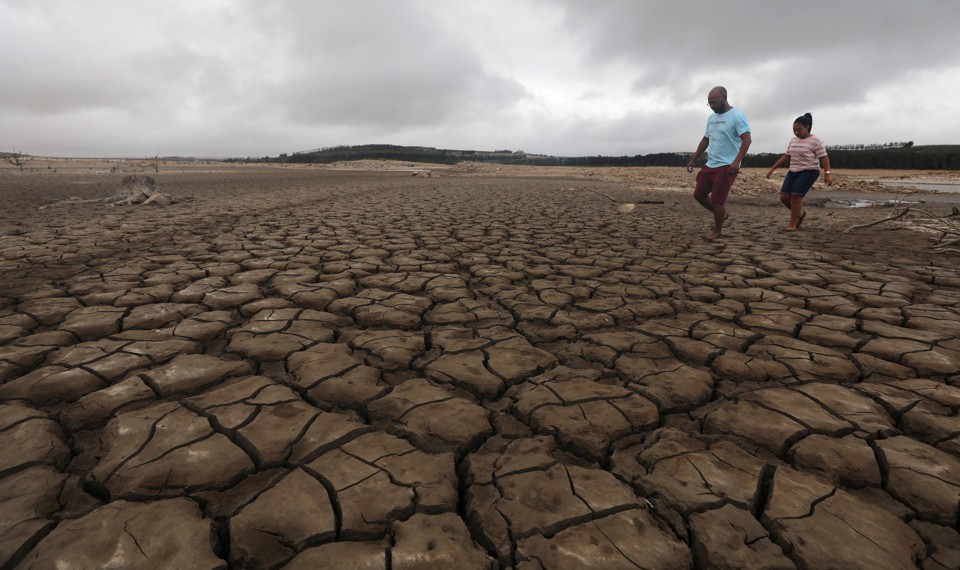 A family negotiates their way through caked mud around a dried up section of the Theewaterskloof dam near Cape Town, South Africa,
The city of Cape Town was plonked by its founders onto a peninsula not far from where the Indian and Atlantic oceans merge, often violently, beneath the imposing banks of Table Mountain. To its north lie the fertile fruit and wine farms that weigh down the city’s restaurant tables with unimaginable bounty. Every day when the clock strikes noon, a cannon blast echoes from Signal Hill, a reminder of the city’s colonial heritage. It was established first as a vegetable garden by the Dutch East India Company in 1652, then repurposed as a stronghold for the British until the formation of the Union of South Africa in 1910; later it served as the apartheid regime’s parliamentary stronghold. In 2014, The New York Timesdeclared it the best place in the world to visit. Britain’s Daily Telegraph concurred.
Today, Cape Town faces two catastrophic, extinction-level botherations. First, the rains that once fell so reliably during the winter months have tailed off. For the past three years, they have barely fallen at all—a phenomenon one meteorologist calls a once-in-628-years weather event. Second, Cape Town is one of the more unequal cities on earth, with the wealthy, mostly white, population living in toney coastal and inland suburbs, and the poor, mostly black, inhabitants shunted onto the flatlands, an hours-long commute from the city’s economic hub.
By current calculations, “Day Zero,” the dystopian term for the date by which the city is expected to run out of water, and when all water will be rerouted to emergency pick up points, is June 4. This will mark the first time that a major modern city has run out of municipal water. In 2008, Barcelona came close. Sao Paulo, the biggest city in the Western Hemisphere, teeters on the brink. The government of Indonesia has given serious consideration to abandoning chunks of Jakarta, which is paradoxically sinking below sea level, drowning in torrential rains, and running out of potable water. What is now certain is that Cape Town will become a test case for what happens when climate change, extreme inequality, and partisan political dysfunction collide.
Perhaps the most confounding thing about Cape Town is its whiplash-inducing contradictions. Its highways, airport, shopping malls, and restaurants, would be the envy of any American municipality. While corruption certainly exists in Cape Town, until the whole place started melting down last year it was the only metro in South Africa to receive clean audits. Yet hundreds of thousands of people live in shacks and informal settlements, with access mostly limited to a shoddy rail system and an expensive private mini-bus taxi network. In this regard, Cape Town is both an African city and a European outpost at the bottom of Africa, at once developing and developed.
So how does an ostensibly well-run city manage to blow the water file so spectacularly? In part, it comes down to the fact that its administration was paralyzed by a sort of bureaucratic magical thinking that combined technocratic hyper-efficiency, an obsession with austerity-driven bean-counting, and an apparent belief that miracles are certain to fall from the sky.
Since 2009, the Western Cape, of which Cape Town is the capital, has been governed by the Democratic Alliance (DA), the official opposition to the African National Congress (ANC). (A DA-led coalition won Cape Town from the ANC in 2006. They now run the city outright.) The DA is a strange beast, a party with a white-dominated federal executive, and, until 2015, a white leader. There’s a longstanding perception that the party serves the white population’s agenda, described by its enemies as maintaining economic apartheid at the expense of black advancement—a notion that Cape Town’s spatial divisions reinforce. (The party’s former leader, Helen Zille, who has also served as Cape Town’s executive mayor, has a habit of posting tweets extolling the benefits of colonialism, which hasn’t helped matters much.) Culturally and politically, the Cape is a world apart from the rest of South Africa.
Accordingly, the DA has long pitched itself to voters as a “clean” version of the horrifically corrupt ANC—it self-identifies as a liberal, social-democratic party in the stodgy German mold. Back when the ANC ran Cape Town, the rains fell mostly on schedule, and planning for the worst took a back seat to systemic corruption. The DA promised that it would do better. Instead, it has been bad, but in its own special ways. Its near-messianic adherence to fiscal rectitude has meant that local bureaucrats have tended to ignore repeated warnings from civil engineers and climate scientists, who insisted that Cape Town’s water infrastructure, which relies exclusively on six dams in parched catchment areas, would not be able to meet demand should rainfall patterns change due to climate change. Theewaterskloof Dam, the biggest and most vital feeder site, is in an area of the Western Cape that has been subject to creeping desertification for at least a decade. It is currently at 11.7 to 12.5 percent of its capacity, and effectively unusable.
The drought is so severe that planning for it would take genuine governmental prescience. But over the years, the Cape Town government has studiously ignored reams of data and studies readily available in the public domain. One of the first warnings that Cape Town would run dry was published in the Cape Timesin 1990. Scientists, meteorologists, engineers and lay-folk have echoed those warnings in the years since. Emergency measures were considered and abandoned, with weather-like caprice: Desalination plants were deemed too expensive and cumbersome for a situation that the city’s bureaucrats believed would resolve itself. A fully completed plant in the nearby Mossel Bay municipality was mothballed in 2011; at slightly less than a dollar a kiloliter, the water it produced was deemed too expensive.
The DA has also encouraged big-money development in the city bowl and in coastal areas, which has massively driven up property prices and made stalwart allies (and donors) of the property developer class. Blue-chip, unsustainable developments populate the rich areas, and critics of the city’s policies insist that they churn through more than their share of water. The irony here is that if the city had been more amenable to mixed-income projects, there’d be far fewer wealthy water consumers along the thirsty coast, and more residents that conserve—largely because they wouldn’t be able to afford to do otherwise.
Of course, you can’t tell this story without mentioning the national government, dominated since the dawn of democracy by the dysfunctional ANC. While South Africa’s constitution placed the municipal water systems under the stewardship of local government, management of the so-called “bulk” national infrastructure—the larger networks that govern water delivery—falls to Department of Water and Sanitation Minister Nomvula Mokonyane. She seems to have no interest in her portfolio. Across the country, because of the usual combination of drought and mismanagement, water shutdowns in smaller communities have become the norm. Mokonyane has blamed the creeping nightmare on over-consumption. Regardless, water for many South Africans is steadily becoming a just another out-of-reach luxury product.
Jacob Zuma, who resigned as South Africa’s presidentand was succeeded by an economy-obsessed, Davos-endorsed technocrat named Cyril Ramaphosa. He is unlikely to be so sanguine regarding Cape Town’s floundering. Compounding all of this is the fact that the Cape Town government was unwilling to admit the scale of the crisis, even to itself, until the middle of last year. In January 2018, the city finally announced that, starting on February 1, households consuming more than 350 liters of water a day would face fines and the installation of a water-management device on their property.
This cued the usual complaints: Why should the wealthy, who pay the most in rates and taxes, effectively subsidize water consumption in poor communities and in the farmlands, while facing a curtailment of the services they effectively underwrite? And why should high-income, tourist-friendly neighborhoods like Mouille Point be forced to host potential desalination plants, noisy eyesores that could just as easily be set up in less “desirable” communities? On the flipside, as a township resident and reporter named Suné Payne put it: “If my household of nine can survive on less than 350 liters of water a day, why can’t others?” In Cape Town, the poor have always faced water restrictions. “There used to be a name for it,” remarked one activist. “Apartheid.”
All of this can be avoided, or at least delayed, if consumption can be choked off at around 450 million liters per day. Farmers have been forced to accept the fact that their crops and vineyards will not receive water that was once shared with the municipality. This means a huge spike in food prices in the coming months. The city has devised what is being called a water pick-up point system, in which approximately 200 sites have been identified from which 25 liters will be distributed to 20,000 eligible residents each a day.
But details on how this scheme will work are sketchy. What contortions must an elderly person or a woman with two children endure in order to schlep all that water? The city also has yet to specify how these points will be policed. According to Richard Bosman, the city’s executive director for safety and security, “The risk grading will be done in accordance with the volume of people expected to pass through each water collection point, as well as the general crime trends in each area. Cape Town does have a number of gang hot spots and so this would be a crucial factor in determining whether a collection point is considered low or high risk.” There has been no elaboration on what this RoboCop-speak means, nor what it would entail. Meanwhile, Patricia De Lille, Cape Town’s executive mayor, has been accused of mismanagement and corruption; she faces a no-confidence vote today.
So what is to be done? In an age in which both the climate and politicians have gone rogue, the only good thing that can come of Cape Town’s crisis is how eloquently its inhabitants come up with new definitions of resilience. What unfolds in the next few months has a massive impact on the lives of all South Africans—cholera won’t stop at the foot of Table Mountain—but it also suggests a way forward for the rest of the world. Drought, or rather climate change, is only part of the reason that Cape Town is dying of thirst. The other failings are more readily addressed, but seem far more intractable.
Monday, March 5, 2018
Saturday, February 24, 2018
1974 in South Africa

Incumbents
State President: Jim Fouché.
Prime Minister: John Vorster.
Chief Justice: Newton Ogilvie Thompson then Frans Lourens Herman Rumpff.

John Voster laying a wreah at Yad Vashem (in 1976 at the invitation of Shimon Peres who visited South Africa in the same year)
Events
January
4 – Harry Schwarz and Chief Minister of KwaZulu Gatsha Buthelezi sign the Mahlabatini Declaration of Faith.
11 – David, Elizabeth, Emma, Grant, Jason and Nicolette Rosenkowitz are born in Cape Town, the first sextuplets in the world where all six babies survive.
March
18 – Members of the World Council of Churches's Executive or Central Committee are banned from South Africa.
19 – The Narcotics Bureau of the South African Police is established.
19 – Harry Schwarz and Chief Minister Cedric Phatudi of Lebowa sign the Seshego Declaration.
April
24 – A whites only general election takes place and is won by the National Party.
25 – A coup in Portugal leads to that country's withdrawal from its colonies in Angola and Mozambique.
May
6 May – The British and Irish Lions begin a controversial twenty-two match rugby union tour of South Africa and Rhodesia.
29 – Prime Minister of South Africa John Vorster and Prime Minister of Rhodesia Ian Smith meet and agree to co-operative co-existence with and non-interference in the internal affairs of a black-ruled Mozambique.

John Voster and Ian Smith
June
5 – The Japanese government announces that South Africans will no longer be granted visas to enter Japan.
July
7 – New Zealand imposes a blanket ban on sports teams from South Africa.
September
22–23 – Prime Minister of South Africa John Vorster and President of Côte d'Ivoire Félix Houphouët-Boignyhold talks.
October
25 – Pik Botha declares at the United Nations that South Africa is beginning to make far-reaching reforms.
November
26 – Anneline Kriel is crowned as Miss World 1974, the second South African to hold the title after Penny Coelen in 1958, when Helen Morgan resigns four days after winning the 24th Miss World pageant.

Then aged 19 and now aged 63
Thursday, April 27, 2017
South Africa celebrates 23 years of Freedom today! Zapiro's archival Mandela Sunrise cartoon 27 April 1994 published then in Weekly Mail.

No No No.....Nelson Mandela , the happy pill of South Africa simply kept the lid on ANC corruption and mismanagement ..... when he went Jacob Zuma and his ANC honchos were all ready in full swing mismanaging the country. Time for Change!! DA instead of ANC!
Celebrate!!!! There is nothing to celebrate. Nearly everything is destroyed. That was drawn in 1994 What he draws now is quite different. SA is destroyed finished and klaar. The latest destruction :- Coligny. Property stolen and destroyed from people who had nothing to do with the drama of a child allegedly killed outside of town. I hope everyone affected will close down and move away.
This is where the current problems started. This cartoon illustrates how South Africans thought that Nelson Mandela's existence would save us all and make life perfect. It took him, and thousands of others, 50 years of extreme hardship, suffering and sacrifice to bring about the end of Apartheid. In 1994 his work was over. It was, and is, up to the rest of us to create a free, decent, just society in which everyone 's basic needs are met. After 342 years of discrimination and oppression of one group by another the right to vote was just one tiny step in what should have been a massive, concerted, well-planned, focused and ongoing effort on the part of every citizen. 23 years later we still haven't learned this lesson. Hence the massive poverty, unemployment and crime.
Saturday, April 8, 2017
We The Whites Of South Africa Manifesto Hey Ho We Better Keep calm … and shut up!

We the South African voters have spoken in the local government election, and we said many different things. Let’s give votes and cities (in part or whole) to the main opposition party, the Democratic Alliance (DA). Let’s give some votes and the municipality where President Jacob Zuma’s homestead of Nkandla is situated to the Inkatha Freedom Party (IFP).
Also, let’s give some votes but no cities to the militant Economic Freedom Fighters (EFF), and small parcels of votes to many, many others.
We as voters have embraced pluralism and competition. It seems to have come as something of a shock to the leaders of the African National Congress (ANC), for some reason. Perhaps the hefty R1 billion the ANC used for campaigning would be better spent on some decent polling.
We also said, as an electorate, let’s take votes – and cities – away from the ANC. Whether the various parties of the opposition attracted our votes, or the ANC leadership repelled us and our votes through their arrogance and brazen corruption, remains a key research question facing academics and politicians.
For local governments in the country’s wealthiest province of Gauteng, in particular, where delivery has been way above the national average, this is a gloomy question. Where did all that hard work go? Was it simply insufficient for a 21st-century “world-class” set of cities?
Why did national credit downgrading matter so much to everyone, but city upgrading by the same agencies of Johannesburg to AA1 status mattered not a jot?
Bluntly, did the rot from the centre suppurate through to voters who may otherwise have rated the metropole of Johannesburg, its mayor Parks Tau and members of the mayoral committee (MMCs) as working well for us? Did we throw out the Tau with the bathwater, in anger and frustration at his ANC overlords?
This question – of blame, simply put – is likely to be at the heart of post-election ANC manoeuvring. Whether the interests of voters will be taken into account is an open question.
Free and fair and (too) fast
To add hubris to the mess, the Independent Electoral Commission (IEC) was brazen enough to host an end-of-election event, declaring the entire endeavour free and fair. This, even while the vote for the economic and provincial capital, Johannesburg, remained incomplete and subject to dispute in multiple wards. Really?
The audacity of the IEC was breathtaking. It would be rather like the Brexit vote being declared while still counting the London votes.
Twitterati breathlessly told us that the IEC emerged from the election well, with its reputation regained after its own tango with corruption and maladministration. Apparently our appetite for a clean institution is so large and urgent that we are willing to allow such incidents to occur, relieved that at least most of the vote had been free and fair, and the IEC seemed to smell of roses.
Then the young women of the EFF stood in mute protest as Zuma spoke at the IEC election centre after the polls in Pretoria. They reminded us of the rape charge and trial of the president a decade ago (he was acquitted), asking profound questions about the moral basis of leadership – and did so just metres away from Zuma, while he bumbled through the usual pleasantries of a captain watching his ship sinking while trying to keep the passengers calm.
Zuma’s security detail – presumably gobsmacked that these young women completely outmanoeuvred their assumed tactical astuteness and training and little plastic ear wires and big guns – were rather less presidential in their handling of the young women.
Strong men shoving around young women – the tableaux acted out exactly what the women were protesting. The women are university students, doing what students do best – cocking a snoop at authority in pursuit of their beliefs. Setting a rather presidential example, it may be noted.
Anti-rape protesters being removed as Jacob Zuma spoke in Pretoria.
Since then, the social media landscape has been alight with awkward camera angles, muffled sound and snippets of gossip – did female ANC cabinet ministers really round on one of their own for the lapse in security? Was Zuma heard shouting his anger? Who were the women? Why were they screaming when led away? Did the rest of the EFF contingent know of the protest, as they hastily made for the door, apparently refusing to listen to Zuma?
Snide, rude and arrogant
But perhaps the worst thing to happen is that someone told DA former party leader and Western Cape Premier Helen Zille she could stop hiding and start tweeting again. Life is tough enough for whiteys without her assuming to insert snide, often rude and arrogant tweets into whatever debate she feels needs her special attention.
Universities have been literally aflame for almost a year, but this did not stop Zille from tweeting to a #feesmustfall group that:
If this woke bunch hate being UCT students so much, pls help them out of their misery and withdraw their funding.
Political writer Richard Poplak has already eviscerated the tweet and the twit who wrote it. Just what we need – stupid, snide, entirely lacking in compassion, suggesting a flatlined learning curve. And unassailably white on the scale of snottiness and lack of empathy.
Not that anyone asked, but if they did I’d say to fellow white voters, “Stay Calm – but (not just you Helen Zille) please shut up!” The massive change we have witnessed; the “new narrative” that has welcomed pluralism and jettisoned the much-peddled factoid of 2014’s national election, that we were all heading to doom, death and decay – or, worse, Zimbabwean basket-case status; these things have not been done by white people, though we may have been part of the change.
Elections are not a racial census
We do not bear “the white man’s [sic] burden” of being the gatekeeper of liberal democracy, even though various commentators over the last 22 years have told us that black people vote blindly for ANC governments – that elections are a racial census.
These supposed political scientists argued for years that the black vote – that key item lying at the heart of the struggle for democracy – was actually the biggest threat to democracy, because the “natives” kept electing ANC governments. If anyone wanted a better example of why the academy needs a dramatic post-colonial overhaul, read 22 years of election analysis, and weep quietly.
But now these have been debunked by us voters. The academics trotting out these tropes have been shown to write utter tosh; and one can only hope that we all accept – and all will accept us – as part of a massive social revolution that began in 1990 and is still taking shape, unravelling from the violence and racism and psychological scarring of the past and moving restlessly into an unknown future.
It cannot do so where whites or blacks silence one another – but it also cannot thrive where black or white claim credit for the victories of democracy.
We – all of us, in our resplendent variety as voters – we did this. Whites did it. Blacks did it. Coloureds did it. Indians did it. Gay and straight, LGBTIAQ+ and staunchly religious conservatives and atheists, surfers and tiddly-winks players, we all did it.
So let’s own it as a collective victory against those who sit in power and disregard us as voting fodder. The only winner in the local elections of 2016 is the only winner that matters – you and I, the South African voter.
Also, let’s give some votes but no cities to the militant Economic Freedom Fighters (EFF), and small parcels of votes to many, many others.
We as voters have embraced pluralism and competition. It seems to have come as something of a shock to the leaders of the African National Congress (ANC), for some reason. Perhaps the hefty R1 billion the ANC used for campaigning would be better spent on some decent polling.
We also said, as an electorate, let’s take votes – and cities – away from the ANC. Whether the various parties of the opposition attracted our votes, or the ANC leadership repelled us and our votes through their arrogance and brazen corruption, remains a key research question facing academics and politicians.
For local governments in the country’s wealthiest province of Gauteng, in particular, where delivery has been way above the national average, this is a gloomy question. Where did all that hard work go? Was it simply insufficient for a 21st-century “world-class” set of cities?
Why did national credit downgrading matter so much to everyone, but city upgrading by the same agencies of Johannesburg to AA1 status mattered not a jot?
Bluntly, did the rot from the centre suppurate through to voters who may otherwise have rated the metropole of Johannesburg, its mayor Parks Tau and members of the mayoral committee (MMCs) as working well for us? Did we throw out the Tau with the bathwater, in anger and frustration at his ANC overlords?
This question – of blame, simply put – is likely to be at the heart of post-election ANC manoeuvring. Whether the interests of voters will be taken into account is an open question.
Free and fair and (too) fast
To add hubris to the mess, the Independent Electoral Commission (IEC) was brazen enough to host an end-of-election event, declaring the entire endeavour free and fair. This, even while the vote for the economic and provincial capital, Johannesburg, remained incomplete and subject to dispute in multiple wards. Really?
The audacity of the IEC was breathtaking. It would be rather like the Brexit vote being declared while still counting the London votes.
Twitterati breathlessly told us that the IEC emerged from the election well, with its reputation regained after its own tango with corruption and maladministration. Apparently our appetite for a clean institution is so large and urgent that we are willing to allow such incidents to occur, relieved that at least most of the vote had been free and fair, and the IEC seemed to smell of roses.
Then the young women of the EFF stood in mute protest as Zuma spoke at the IEC election centre after the polls in Pretoria. They reminded us of the rape charge and trial of the president a decade ago (he was acquitted), asking profound questions about the moral basis of leadership – and did so just metres away from Zuma, while he bumbled through the usual pleasantries of a captain watching his ship sinking while trying to keep the passengers calm.
Zuma’s security detail – presumably gobsmacked that these young women completely outmanoeuvred their assumed tactical astuteness and training and little plastic ear wires and big guns – were rather less presidential in their handling of the young women.
Strong men shoving around young women – the tableaux acted out exactly what the women were protesting. The women are university students, doing what students do best – cocking a snoop at authority in pursuit of their beliefs. Setting a rather presidential example, it may be noted.
Anti-rape protesters being removed as Jacob Zuma spoke in Pretoria.
Since then, the social media landscape has been alight with awkward camera angles, muffled sound and snippets of gossip – did female ANC cabinet ministers really round on one of their own for the lapse in security? Was Zuma heard shouting his anger? Who were the women? Why were they screaming when led away? Did the rest of the EFF contingent know of the protest, as they hastily made for the door, apparently refusing to listen to Zuma?
Snide, rude and arrogant
But perhaps the worst thing to happen is that someone told DA former party leader and Western Cape Premier Helen Zille she could stop hiding and start tweeting again. Life is tough enough for whiteys without her assuming to insert snide, often rude and arrogant tweets into whatever debate she feels needs her special attention.
Universities have been literally aflame for almost a year, but this did not stop Zille from tweeting to a #feesmustfall group that:
If this woke bunch hate being UCT students so much, pls help them out of their misery and withdraw their funding.
Political writer Richard Poplak has already eviscerated the tweet and the twit who wrote it. Just what we need – stupid, snide, entirely lacking in compassion, suggesting a flatlined learning curve. And unassailably white on the scale of snottiness and lack of empathy.
Not that anyone asked, but if they did I’d say to fellow white voters, “Stay Calm – but (not just you Helen Zille) please shut up!” The massive change we have witnessed; the “new narrative” that has welcomed pluralism and jettisoned the much-peddled factoid of 2014’s national election, that we were all heading to doom, death and decay – or, worse, Zimbabwean basket-case status; these things have not been done by white people, though we may have been part of the change.
Elections are not a racial census
We do not bear “the white man’s [sic] burden” of being the gatekeeper of liberal democracy, even though various commentators over the last 22 years have told us that black people vote blindly for ANC governments – that elections are a racial census.
These supposed political scientists argued for years that the black vote – that key item lying at the heart of the struggle for democracy – was actually the biggest threat to democracy, because the “natives” kept electing ANC governments. If anyone wanted a better example of why the academy needs a dramatic post-colonial overhaul, read 22 years of election analysis, and weep quietly.
But now these have been debunked by us voters. The academics trotting out these tropes have been shown to write utter tosh; and one can only hope that we all accept – and all will accept us – as part of a massive social revolution that began in 1990 and is still taking shape, unravelling from the violence and racism and psychological scarring of the past and moving restlessly into an unknown future.
It cannot do so where whites or blacks silence one another – but it also cannot thrive where black or white claim credit for the victories of democracy.
We – all of us, in our resplendent variety as voters – we did this. Whites did it. Blacks did it. Coloureds did it. Indians did it. Gay and straight, LGBTIAQ+ and staunchly religious conservatives and atheists, surfers and tiddly-winks players, we all did it.
So let’s own it as a collective victory against those who sit in power and disregard us as voting fodder. The only winner in the local elections of 2016 is the only winner that matters – you and I, the South African voter.
Subscribe to:
Posts (Atom)